

Key Takeaways
- ERP implementations struggle when financial, operational, and data maturity lag behind business complexity.
- ERP reveals if reporting is reliable, data is trusted, controls can scale, and leaders can make timely decisions.
- Mid market companies modernize responsibly by fixing data quality, aligning systems to strategy, managing change, and integrating risk early.
Legacy enterprise resource planning (ERP) software can limit an organization’s ability to scale. As companies grow, older ERP platforms often create friction through high maintenance costs, limited reporting capabilities, and increased security and compliance risk.
For mid market leaders, ERP issues are often early warning signs that growth is outpacing current systems.
- Dive Deeper: Why Mid-Market Companies Break During Rapid Growth
How Do I Know It’s Time to Replace our ERP?
If your ERP system is becoming more expensive to maintain, harder to adapt, or less capable of supporting reporting and compliance needs, it may be time to consider modernization.
Here are key signs your ERP is slowing growth or not supporting it.
High total cost of ownership
Older ERP systems consume disproportionate budgets through maintenance, upgrades, and custom fixes. These costs crowd out innovation and prevent reinvestment in analytics, automation, and decision support tools.
Modern cloud based ERP platforms reduce reliance on infrastructure and long term maintenance burdens, allowing organizations to shift resources toward advancing business outcomes. In fact, Forrester found that this transition can reduce Total Cost of Ownership by up to 14%.
Inflexibility and Customization Debt
Years of bespoke configurations often become technical debt. Each customization increases risk, slows innovation, and weakens integration with modern tools across CRM, planning, e-commerce, and reporting.
Further, over engineered workflows and outdated controls make ERP harder to manage. Manual interventions, inconsistent approvals, and legacy security models leave organizations exposed as volume and complexity increase.
Instead of simplifying operations, ERP becomes something teams work around rather than through.
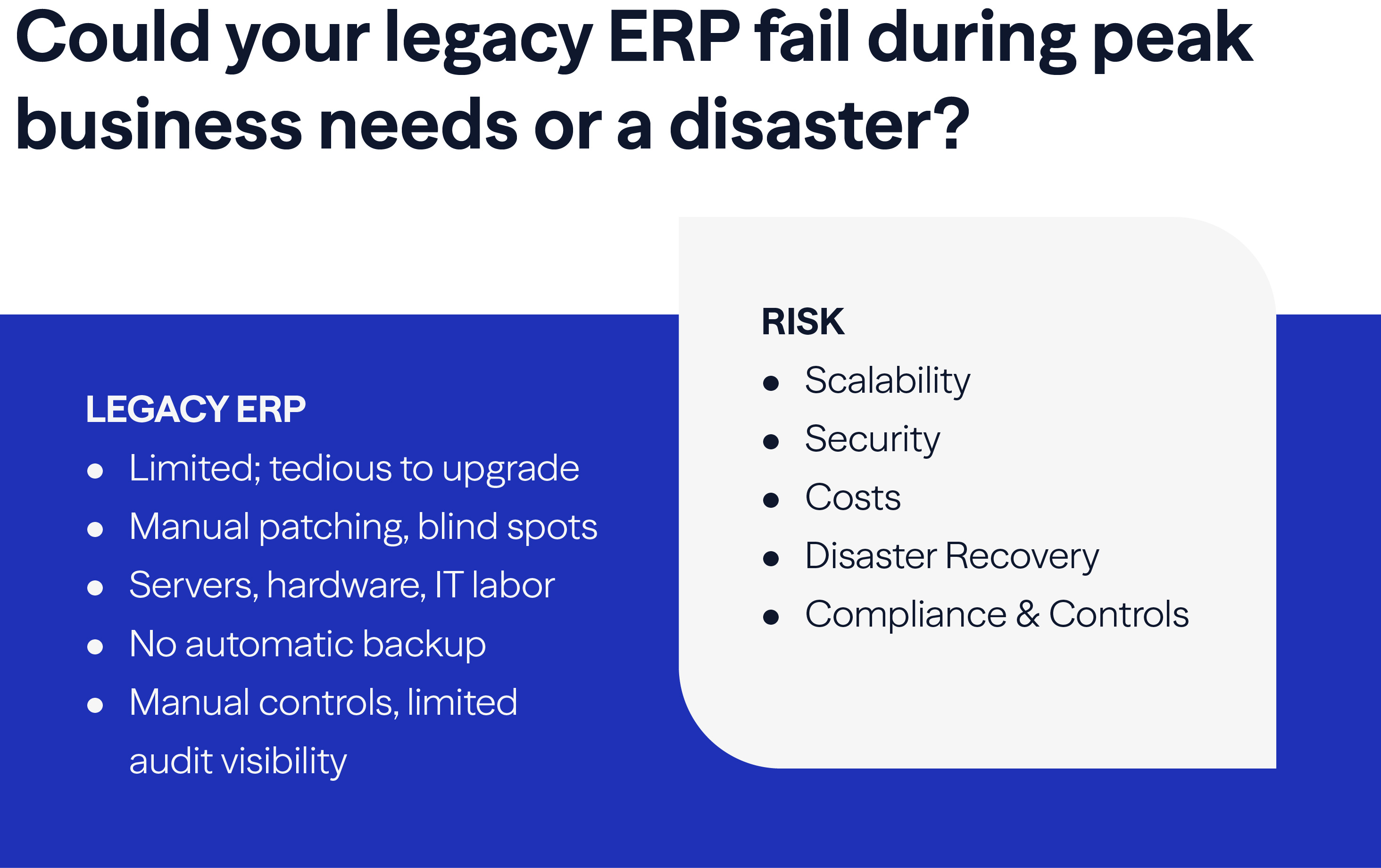
On-premise Limitations
On-premise environments can become harder to secure, support, and scale over time. That matters less because they are on-premise and more because they can’t keep pace with reporting expectations, integration needs, and ongoing change.
For many organizations, modernization is really about creating flexibility: the ability to add entities, support new workflows, improve data access, and keep moving without turning every change into a major project.
Data Fragmentation and Delayed Reporting
Multiple ERP instances and disconnected modules create inconsistent data and unreliable analytics.
You’re constantly struggling to unlock data that’s buried in the ERP (or other disconnected systems and spreadsheets). Without a centralized, secure view of financial and operational data, it’s harder to catch discrepancies, prevent fraud, or flag compliance issues early. Reporting becomes manual, reconciliation heavy, and prone to error.
This is often where ERP strain surfaces first: in finance. When data can’t be trusted, growth decisions slow, and risk increases.
How do We Modernize ERP Responsibly?
ERP modernization should be approached as part of a broader business and technology strategy, not just as a software replacement project.
Successful ERP modernization includes:
- Starting with business alignment: define why the change matters, what success looks like, and what the organization is willing to change.
- Designing reporting structures, segments, and dimensions around how leaders need to run the business today and in the future.
- Addressing data quality issues before migration, especially around master data, reconciliations, negative inventory, and duplicate records.
- Building governance early by naming internal ownership, change approval authority, and a clear process for deferring out-of-scope requests.
- Reducing technical debt: replace customizations and redundant tools with more scalable capabilities.
- Change management and ROI tracking: define rollout phases, training needs, and success metrics before implementation begins.
Technology should always help, not hinder, your business.
Ask: Does this technology initiative directly advance business objectives?
That also means being honest about risk. As systems become more connected and automation becomes more important, weak controls, poor data discipline, and unclear ownership create downstream issues quickly.
Common ERP Implementation Mistakes
Even well intentioned ERP initiatives struggle when teams overlook foundational issues.
Common gaps include:
- Starting with software instead of readiness: selecting a platform before the business has aligned on processes, decision rights, reporting needs, and ownership.
- Lifting and shifting broken processes: recreating old workarounds in a new system rather than configuring around policy, scale, and the future-state operating model.
- Ignoring data integrity: migrating duplicate, unreconciled, or poorly structured data and expecting the new ERP to fix it later.
- Underinvesting in change management: assuming adoption will happen because the system is live. Prosci’s benchmarking shows projects with excellent change management are about seven times more likely to meet or exceed objectives than those with poor change management.
- Designing for today only: choosing structures that cannot absorb acquisitions, new business lines, location growth, automation, or AI use cases without major redesign.
ERP planning must address these risks early, not after implementation.
- Dive Deeper: Is Your Risk Strategy Built for a Digital Future?
Top Questions to Ask Before Your ERP Upgrade
-
What are the biggest risks with our current ERP system?
-
Evaluate for security gaps, downtime risk, compliance blind spots that could disrupt operations.
-
-
Does our ERP align with our long-term growth strategy?
-
Make sure it can scale with new products, services, or locations.
-
-
What hidden costs exist in maintaining the status quo?
-
Factor in licensing, patches, downtime, custom workarounds, IT staffing to understand the true cost of on-premise systems.
-
-
How will we manage security and compliance in the new system?
-
Prioritize built-in controls like access management, audit trails, and data protection.
-
-
Is our data clean, accessible, and migration-ready?
-
Remember: garbage in, garbage out — data quality drives ERP success.
-
-
How will the new ERP integrate with our other core systems?
-
Confirm seamless connections with CRM, HR, payroll, supply chain, etc. to avoid silos.
-
-
Do we have the right talent and resources for implementation?
-
Secure internal champions and external expertise to drive adoption and long-term success.
-
-
How will this ERP improve decision-making for leadership?
-
Look for real-time dashboards, KPI visibility, and forecasting tools.
-
-
What’s our plan for change management and user adoption?
-
Invest in training, communication, and leadership alignment from the start.
-
-
How will we measure ROI post-implementation?
-
Define success through cost savings, efficiency gains, improved compliance, and reduced risk.
-
ERP Is a Strategic Test of Growth Readiness
ERP is not just a technology investment. For growing mid market organizations, it’s often the moment systems reveal whether growth is truly sustainable.
When ERP struggles, it typically precedes:
- Reporting breakdowns
- Control weaknesses
- Audit and diligence challenges
- Slower, riskier decision making
Eide Bailly’s Mid Market Growth resources help leaders understand the signals, systems, and decisions required to scale without losing control.
Learn more: Middle-Market Insights: Strategy, Growth, and Readiness
Frequently Asked Questions
How do I know it’s time to replace our ERP?
When reporting is slow, data isn’t trusted, and growth requires constant workarounds, your ERP is no longer supporting scale.
Why do ERP implementations fail in mid market companies?
Because systems, data, and controls aren’t mature enough to support increased complexity—even with strong vendors.
How can companies modernize ERP without increasing risk?
By fixing data, processes, and governance first, aligning systems to outcomes, and integrating risk management into planning.

Get insight at the speed of now with accurate, reliable data.
Create a lasting digital future for your organization.
Who We Are
Eide Bailly is a nationally ranked accounting and advisory firm bringing financial, operational, and technical solutions to middle market and high-growth organizations.