


Key Takeaways
- Credits and incentives are now business strategy tools, influencing capital allocation, expansion, innovation, and investment decisions, not just reducing tax liability.
- Organizations that factor incentives into planning early can improve cash flow, accelerate ROI, strengthen funding discipline, and make more informed growth decisions.
- The biggest opportunities are often found by evaluating incentives before key decisions are made and embedding them into ongoing financial and operational planning processes.
Most organizations are making capital, hiring, and expansion decisions without a complete financial picture. In fact, an Eide Bailly survey found that 56% of business leaders are currently not evaluating credits and incentives when planning upcoming projects. That's not just a tax issue; it's a strategic blind spot.
The question is no longer about what credits you can claim. Instead, it’s about how incentives will help shape what you do next. Mid-market companies that don’t account for incentives early on may be leaving significant value on the table.
Why Business Credits & Incentives Matter More Than Ever
Over the past several years, the structure and scope of credits and incentives have evolved. With legislation like the Inflation Reduction Act, the One Big Beautiful Bill, and other federal and state initiatives:
- The volume and variety of incentives have expanded
- Eligibility categories have expanded
- Monetization options like transferability and direct pay have made incentives more accessible
In addition, businesses investing in facilities, equipment, and other eligible capital construction projects may benefit from 100% bonus depreciation, allowing for the immediate expensing of qualifying capital expenditures and accelerating cash-flow benefits.
Research shows that approximately $16.79 billion of economic incentives were awarded in 2025, tied to over $166 billion in capital investment and over 564,000 new jobs. This reinforces how quickly incentive strategy has merged with site selection, labor planning, and economic development.
Further, the IRS provides structured incentive guidance spanning clean electricity, advanced manufacturing, carbon sequestration, energy-efficient buildings, and research and development (R&D).
This means credits now shape decisions such as:
- Project prioritization, structure, and timing
- Equipment procurement
- Funding expansion and investment focus
- Facility expansion and site selection
- Workforce development strategies
- Product and technology development
Industry Outlook: Construction
The shift is evident across industries, with incentives reaching into financial institutions, software, manufacturing, nonprofits, healthcare, construction, and expanding middle-market businesses.
In construction and real estate, sustainability-related incentives are increasingly shaping project design and investment decisions. As regulatory requirements and energy-efficient building demands expand, companies are using incentives to offset costs, meet compliance expectations, and differentiate in the market.
Incentives as a Lever for Better Business Performance
For financial and operational leaders, credits and incentives are no longer just tax considerations. They can free up cash flow, improve ROI, shape expansion decisions, fund modernization and innovation, and create competitive advantage by enabling investments others may delay or overlook.
Here are four areas to consider:
1. Capital Allocation
Every major investment decision carries trade-offs: where to deploy capital, how much to invest, and what returns to expect.
Capital allocation decisions are only as good as the assumptions behind them. Incentives can materially improve project economics, change ROI calculations, and unlock additional investment capacity.
Industry Example: Construction & Real Estate
For one real estate developer, the strategic use of incentives dramatically changed the project's economics. By leveraging cost segregation and 179D energy-efficiency deductions, the organization and Eide Bailly identified up to $14 million in deductions and up to $5 million in tax savings. The additional cash flow improved financial flexibility, freed up capital for future projects, and strengthened the organization's ability to continue investing in growth.
2. Funding Discipline
Incentives help organizations structure and evaluate projects more strategically.
To fully realize value, organizations must:
- Align projects with program requirements, including wage thresholds, domestic sourcing, and workforce criteria
- Document activities in real time
- Design projects with eligibility in mind
This creates a more rigorous approach to planning, justifying, and executing investments.
Industry Example: Technology
A technology company improved its financial standing by utilizing state incentive programs that awarded no-interest loans to support their upcoming project. That same company was also able to utilize grants through the local entities to finance their capital investments.
The result of utilizing these tools led to a greater ROI and improved cash-flow, helping their organization to achieve greater company-wide goals that might not have been pursued otherwise.
3. Cash Flow Optimization
With the rise of transferability and direct pay, incentives are no longer just deferred tax benefits; they can be converted into immediate liquidity.
This allows organizations to:
- Recycle capital into new investments more quickly
- Reduce reliance on external financing
- Strengthen short-term and long-term cash flow positions
Industry Example: Manufacturing
A manufacturing company experienced rapid growth that exposed inefficiencies and limited its ability to fully capture available incentives. By modernizing their financial operations and aligning strategy across teams, they:
- Streamlined and standardized processes
- Improved financial visibility and audit readiness
- Increased available tax credits by 4x
- Reduced inefficiencies and unlocked additional cash flow
4. Timing as a Strategic Advantage
Timing is one of the most overlooked yet most critical factors in incentive value.
Eligibility is often determined by decisions made early in the process:
- Before hiring plans are finalized
- Before locations are selected
- Before capital projects are approved
- How projects are structured before execution
Year-End Planning Decisions
For many organizations, the most important incentive-related decisions happen before the project or production begins.
Instead of waiting for a project to be complete or a tax deadline, financial leaders should be asking:
- Are we structuring projects to maximize eligibility for federal, state, or local programs?
- Are our contracts structured to capture and monitor the requirements to fully utilize or monetize credits?
- What capital investments need to be approved or accelerated before year-end?
- How do current and projected tax positions affect our ability to utilize or monetize credits?
- Are there opportunities to improve the timing of cash flows through credit strategies?
- What budget assumptions should be adjusted to reflect available incentives?
What Leading Organizations Do Differently
For many leaders, the challenge in tax credit and incentive planning is keeping up with changing rules and determining eligibility. Forward-thinking organizations treat incentives as part of how the business runs, not just how taxes are filed. This includes modeling incentives into capital planning, factoring incentives into ROI and payback periods, and ultimately using them to evaluate investment opportunities.
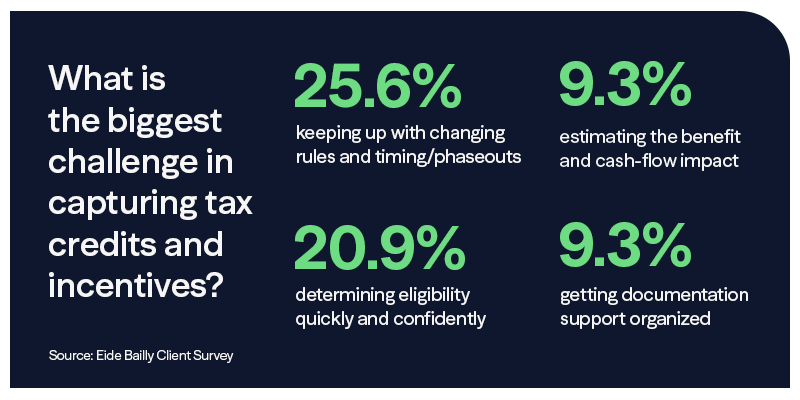
Further, over 30% of business leaders in a recent Eide Bailly survey noted that incentive timing rules and deadline tracking will be critical to get right in 2026 and beyond. For some incentives, taxing authorities already require pre-filing registration and maintaining extensive documentation for implementation. Companies should expect continued refinement to forms, rules, eligibility interpretations, documentation requirements, and filing processes.
Therefore, the strongest mid-market companies will create repeatable governance models for incentives, including standardized workflows for eligibility identification and documentation and compliance processes.
Where to Start
As we often tell our clients, every strategy needs to be tied to your larger business goals. Even with business credits and incentives planning, it’s important to start by pressure-testing your current state:
- Where are we already doing activities that could qualify for incentives?
- What decisions are we making without factoring incentives into the financial model?
- Who needs to be involved earlier in the process?
- How do we turn this into a repeatable capability instead of a one-off effort?
Organizations that answer these questions often discover they're already undertaking activities that qualify for incentives but aren't being tracked, modeled, or incorporated into strategic planning.
Industry Example: Manufacturing
Growth often creates opportunities that organizations don't have the bandwidth to identify on their own. One rapidly expanding manufacturer acquired or expanded into more than 15 business units across the country in just two years. By coordinating financial and technical stakeholders across the organization, the company and Eide Bailly identified and documented activities that generated more than $1.5 million in federal and state R&D tax credits. The project also created a foundation for additional incentive opportunities, further improving cash flow and financial performance.
Embedding Incentives into How the Business Runs
To turn incentives into a true operational advantage, organizations need to build them into everyday decision-making.
That means:
- Integrating incentives into financial planning, not as a year-end adjustment, but as part of forecasting, budgeting, and capital modeling.
- Aligning finance and operations by ensuring the teams making hiring, expansion, and investment decisions understand the financial implications of incentives.
- Creating forward-looking visibility by identifying opportunities before decisions are locked in, not after.
- Establishing repeatable processes to make incentive capture consistent, scalable, and predictable.
Incentives should no longer be evaluated after the year closes. Instead, asking ‘what credits and incentives are available,’ should be a part of the evaluation of each strategic initiative. When incentives are integrated into strategy, organizations gain a clearer view of their options and are better positioned to invest, grow, and compete.
The question isn’t whether incentives apply to your organization. It’s whether you’re factoring them in early enough to make a difference.
Are your growth and investment decisions built on a complete financial picture?
Our Business Credits & Incentives Assessment helps identify missed opportunities and uncover where incentives can improve cash flow, ROI, and strategic decision-making.
Frequently Asked Questions
What are business tax credits and incentives?
Business tax credits and incentives are federal, state, and local programs that provide financial benefits to organizations for activities such as investment, hiring, innovation, and energy projects, and increasingly serve as strategic tools influencing capital allocation, expansion decisions, and overall financial performance.
Why are credits and incentives considered a business strategy, not just a tax strategy?
Credits and incentives are considered a business strategy because they directly affect return on investment, cash flow, and investment decisions, and when incorporated early, they can change which projects move forward, where companies expand, and how initiatives are funded.
How do incentives improve cash flow?
Incentives not only improve cash flow by directly reducing tax liabilities, incentives can also enable organizations to monetize credits through mechanisms such as transferability, in which credits can be sold for cash, and direct pay, in which eligible organizations receive refundable payments, creating immediate liquidity that can be reinvested in the business.[M(5.1][KH5.2] In addition, R&D credits can be monetized against payroll taxes for start-ups, and 100% bonus depreciation incentives accelerate deductions in the current year, reducing taxable income and increasing cashflow earlier.
When should companies evaluate credits and incentives?
Companies should evaluate credits and incentives before finalizing key business decisions such as capital investments, hiring, facility expansion, and project design, because evaluating them too late often results in missed eligibility or reduced financial benefit.
What types of business activities typically qualify for incentives?
Many common business activities qualify for incentives, including capital investments in facilities and equipment, research and development, hiring and workforce training, energy-efficiency initiatives, and manufacturing or supply-chain expansion.
How are incentives used in site selection and expansion decisions?
Incentives are used in site selection and expansion decisions by helping organizations evaluate competing locations, negotiate economic development packages, and improve the financial viability of projects, with earlier engagement increasing access to programs and negotiating leverage.
What role do incentives play in year-end planning?
Incentives play a critical role in year-end planning by influencing the timing of capital expenditures, tax positions, credit utilization, monetization opportunities, and budget assumptions, with decisions made before year-end often determining the total value realized.
How can organizations build a repeatable incentives strategy?
Organizations can build a repeatable incentives strategy by embedding incentives into financial planning and forecasting, aligning tax, finance, and operations teams, identifying opportunities early, and creating structured processes for documentation and compliance.
Are incentives only relevant for certain industries?
Incentives are not limited to specific industries and now apply broadly across all industries, including: manufacturing, healthcare, technology, construction, and nonprofits, as any organization that makes investments, hires employees, or pursues growth initiatives may qualify.
What is the first step to improving our incentives strategy?
The first step to improving an incentives strategy is to assess where the organization is already undertaking qualifying activities, identify decisions being made without considering incentives, and evaluate alignment across teams to uncover missed opportunities.
We have the tax expertise to meet your business needs.
Increase your organization’s cash flow by benefiting from available tax credits and deductions.
Who We Are
Eide Bailly is a nationally ranked accounting and advisory firm bringing financial, operational, and technical solutions to middle market and high-growth organizations.