

Key Takeaways
- Sustainable growth requires visibility, readiness, and strategic alignment before major investments or expansion.
- Middle-market companies often encounter growth constraints when financial reporting, technology, and processes fail to scale with the business.
- Leaders who proactively address growth, technology, capital, and succession challenges are better positioned to navigate disruption and create long-term value.
Middle-market companies face a unique challenge. They are often too complex for small-firm solutions and too nuanced for enterprise approaches that can introduce unnecessary cost and complexity. As organizations grow, leaders must navigate a series of critical business decisions involving operations, technology, talent, capital, and ownership transition. The companies that succeed are not necessarily the ones that react fastest. They are the ones that prepare before growth exposes weaknesses.
Why Middle-Market Companies Struggle to Scale
Growth often exposes problems that already exist. As revenue increases, leaders frequently discover:
- Financial reporting cannot keep pace with business demands.
- Operational processes remain heavily dependent on spreadsheets and manual work.
- Technology investments fail to deliver expected outcomes.
- Decision-makers lack real-time visibility into performance.
- Leadership teams become misaligned around priorities.
These issues rarely emerge overnight. They develop gradually until growth, acquisition activity, capital investment, or ownership transition creates enough pressure to reveal them.
Before pursuing expansion, business leaders should assess whether their organization is prepared to operate at the next stage of maturity. As a firm specializing in middle-market companies, we typically see four key inflection points surrounding growth planning, systems, transition, and continuity. Here’s how to address them head on.
The Four Inflection Points of Middle-Market Companies
Middle-market businesses are not immune to today’s economic climate. In fact, over 90% of middle-market CEOs say inflation is their top deterrent to growth. Couple this with concerns around tariff policies, rising interest rates, and customer retention, and middle-market organizations stand at a critical juncture.
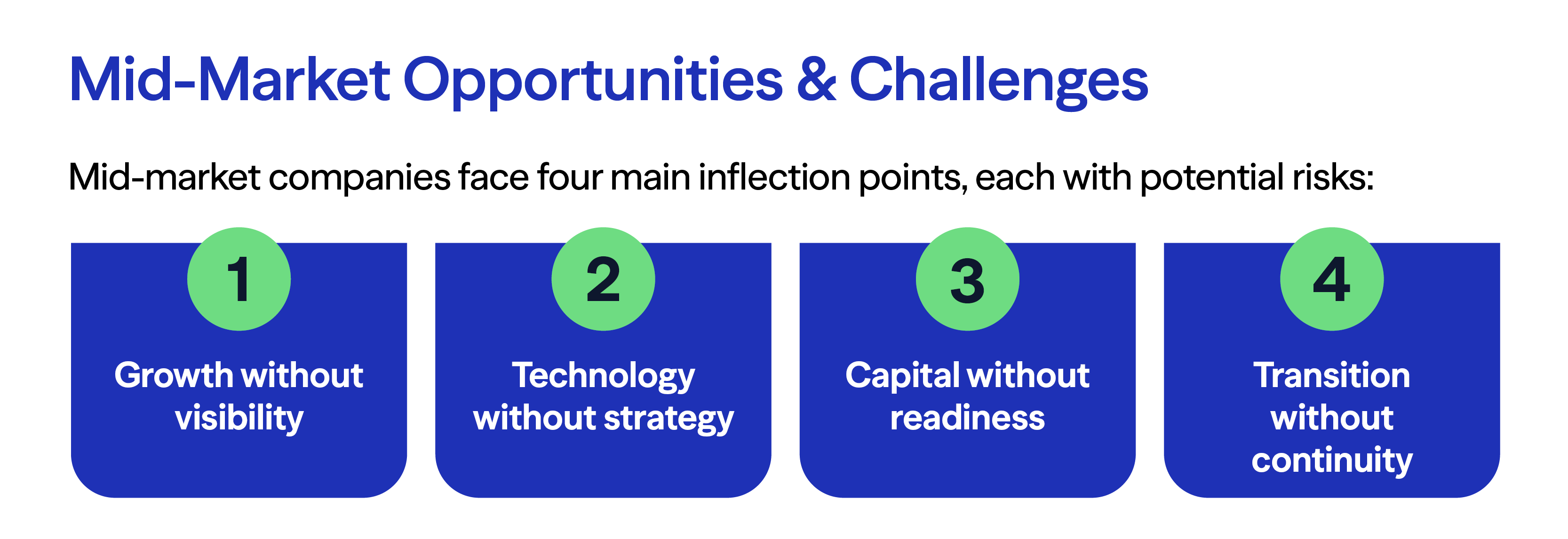
Mid-market companies face four main inflection points, each with potential risks:
Mid-Market Opportunities & Challenges
Mid-market companies face four main inflection points, each with potential risks:
Visibility is the Foundation for Growth
When financial and operational data live in disconnected systems, leadership teams often spend more time reconciling information than acting on it. Over 50% of business leaders cite access to accurate, timely, trusted data as their biggest challenge.
- Hiring
- Capital investments
- Pricing
- Expansion opportunities
- Customer profitability
- Cash flow
Take Black Clover, for example. As a young company, they used disparate systems that resulted in data silos and inaccurate reporting. Together, we created a data warehouse for a single source of truth across every department. This, coupled with a custom reporting solution, gave the company complete visibility into their business. The result? 400% growth.
Signs Your Financial Reporting May Not Scale
For CFOs and financial leaders, common warning signs include:
- Month-end close processes require excessive manual effort.
- Data must be reconciled across multiple systems.
- Forecasts are frequently inaccurate.
- KPIs differ across departments.
- Leadership waits weeks for critical performance information.
Organizations that address these issues early gain the visibility necessary to support sustainable growth.
Technology Without Strategy Will Fail
AI is the leading driver of investment dollars for middle-market companies and more than half of companies say they will invest in artificial intelligence tools soon.
However, companies that invest without a solid strategy and governance model are destined to fail. Gartner has estimated that 60% of AI projects will be abandoned because they lack AI-ready data. Companies must first ensure their existing technology is up to date, their data is clean and accurate, and their technology objectives align with overall business priorities. Only then will an AI initiative be successful.
Remember: not every AI project needs to be groundbreaking. For middle-market clients, some of the best results come from automating routine tasks, such as invoice approvals or syncing customer data across systems.
What Owners Need to Know Before Pursuing Growth Opportunities, Capital Infusion, or Transition
Revenue growth in the middle-market has risen to 11.7%. At the same time, research shows one in three midsize businesses say the amount of investment capital available is insufficient for current needs.
In an environment where growth opportunities are elevated but capital is limited, how do middle-market businesses prepare? It all starts with readiness.
Ask yourself:
- Do you have clarity about where your company is going and how it will get there?
- Do you have accurate, concrete data to drive key decisions?
- Do you have documented core processes and compliance around those processes?
- Do you have alignment to your top priorities for the next 12-24 months?
- Do you have skill gaps or training issues with your team?
- What emerging trends and technologies are impacting your team?
Research shows CEOs who revisit strategic priorities quarterly are more likely to pivot successfully in the face of disruption.
Industry Spotlight: Manufacturing
Manufacturing is poised for substantial opportunity, fueled by federal investment in infrastructure and green initiatives. At the same time, the sector faces a wave of leadership transitions as many baby boomer owners — representing roughly 125,000 firms and 2.6 million jobs—consider succession.
Strengthening the industry means supporting succession planning, prioritizing reinvention and expansion, and providing flexible supply chain and staffing solutions.
Plan Early for What's Next
Opportunities for expansion and reinvention are on the minds of many middle-market businesses.
Consider:
- Over 60% of middle-market merger and acquisition professionals are anticipating an increase in deals within the next six months
- 56% of CEOs are planning to expand offerings
- 37% are planning to expand to new regions
Although there is cautious optimism in the middle-market, many companies have not adequately prepared for transition.
Before pursuing aggressive growth, capital investment, acquisition activity, or ownership transition, consider the following:
Strategic Readiness
- Do we have a clearly documented growth strategy?
- Are leadership priorities aligned?
- Do we revisit our strategy regularly?
Financial Readiness
- Are our financial reports accurate and trusted?
- Can we confidently forecast future performance?
- Do we understand profitability by business segment?
Operational Readiness
- Are key processes documented and scalable?
- Can operations support future growth?
- Do we have visibility across departments?
Technology Readiness
- Are our systems supporting or limiting growth?
- Is our data reliable and accessible?
- Do we have a roadmap for modernization?
Workforce Readiness
- Do we have leadership succession plans?
- Are critical skill gaps identified?
- Are employees prepared for future changes?
Organizations that answer "no" to several of these questions may benefit from strengthening foundational capabilities before pursuing aggressive expansion initiatives.
What CEOs and CFOs Often Overlook During Rapid Growth
As organizations become more complex, leaders often focus on revenue growth while overlooking foundational business capabilities.
Common growth-stage blind spots include:
- Operational Alignment: Departments may pursue conflicting priorities, resulting in inefficiencies and slower execution.
- Decision-Making Quality: Without a single source of truth, strategic decisions become based on assumptions instead of facts.
- Process Scalability: Processes that worked at $20 million in revenue frequently break down at $100 million.
- Technology Debt: Legacy systems can limit visibility, automation, and future innovation.
The cost of addressing these issues increases significantly once growth accelerates.
How Middle-Market Companies Move Forward
Growth, AI adoption, expansion, capital planning, and ownership transition all require organizations to make increasingly complex decisions.
The most successful middle-market companies focus on strengthening the fundamentals before pursuing transformational change. They create visibility across the organization, align technology with strategy, invest in scalable operations, and prepare leadership teams for the future.
Whether the next chapter involves growth, acquisition, technology modernization, succession planning, or strategic reinvention, preparation remains the most important competitive advantage.
The middle-market companies that thrive aren’t the ones that react fastest. They’re the ones that prepare through visibility, strategy, readiness, and continuity.
Let us help you thrive – no matter what comes next.
Frequently Asked Questions
What is considered a middle-market company?
Middle-market companies typically generate between $25 million and $750 million in annual revenue. They are large enough to face complex financial, operational, and regulatory challenges, but often lack the internal resources or scale of enterprise organizations.
Why are middle-market companies often underserved?
The middle-market is too complex for small firms and too nuanced for enterprise models. Small firms struggle with scale and specialization, while enterprise firms often over engineer solutions, creating unnecessary cost and friction.
Why should middle-market organizations work with Eide Bailly?
At Eide Bailly, we work exclusively with middle-market organizations navigating these moments. As a full-service CPA and advisory firm, we help leaders align financial insight, operational reality, and long-term strategy —so decisions made at inflection points create momentum, not disruption.
What are the most common inflection points for middle-market companies?
The most common inflection points include growth without visibility, technology without strategy, capital without readiness, and transition without continuity.
What should business owners focus on before pursuing growth or capital?
Owners should focus on clarity of strategy, reliable financial data, documented processes, leadership alignment, and readiness for change before pursuing growth, capital, or transition.
Why do middle-market companies struggle to scale?
Middle-market companies often struggle to scale because systems, reporting processes, workforce capabilities, and operational structures fail to keep pace with growth. As complexity increases, limitations that were previously manageable become significant barriers to performance.
How can CFOs improve visibility before pursuing growth?
CFOs can improve visibility by establishing reliable financial reporting, integrating business systems, defining consistent KPIs, improving forecasting processes, and creating a single source of truth for financial and operational data.
What risks do CEOs often overlook during rapid growth?
CEOs frequently underestimate operational complexity, technology limitations, workforce readiness, succession planning needs, and the importance of integrated financial and operational planning.
How should middle-market companies evaluate AI investments?
Organizations should first assess data quality, system integration, governance practices, business objectives, and operational readiness before investing in AI technologies.
What are the warning signs that systems and processes are holding back growth?
Indicators include excessive manual work, duplicate data entry, delayed reporting, process bottlenecks, poor user adoption, and increasing difficulty supporting customer and employee needs.
What does growth readiness mean?
Growth readiness is an organization's ability to support expansion through scalable operations, reliable financial information, aligned leadership, adaptable technology, and a well-defined strategy.
When should a company bring in outside advisors?
Companies often benefit from outside advisors during periods of rapid growth, technology transformation, succession planning, transaction activity, capital raises, or when leadership lacks visibility into key business challenges.

Our outsourcing advisors will work with you to improve operations and increase performance.
Create a lasting digital future for your organization.
Who We Are
Eide Bailly is a nationally ranked accounting and advisory firm bringing financial, operational, and technical solutions to middle market and high-growth organizations.