

Key Takeaways
- High-performing organizations turn trusted data into faster decisions, stronger performance, and improved profitability.
- Operational, financial, and technology intelligence help leaders identify risks, optimize resources, and respond to change with confidence.
- AI success depends on a strong foundation of connected systems, quality data, and effective governance.
Profitability now depends on how quickly organizations turn data into decisions. To stay competitive, leaders need trusted, integrated data that connects operations, finance, and technology for a unified view of performance.
When leaders understand how these areas intersect, they make faster decisions, allocate resources more effectively, and respond to change with confidence.
However, many mid-market organizations still face siloed systems, inconsistent metrics, and delayed reporting. In fact, 90% of executives believe they risk losing their competitive edge if they cannot operate in real time.
Here’s how operations, finance, and technology leaders can work together to unlock data visibility and use it to drive sustainable profitability.
Operational Intelligence
Growth can cause greater complexity in any organization. With more locations, more systems, more products, and more employees comes more data. And with more data comes an overwhelming amount of information. Visibility helps simplify this complexity.
A survey of Eide Bailly clients found that more than 20% of leaders are focused on improving data quality, structure, and accessibility before pursuing broader AI initiatives.
Centralized, real-time data transforms operations. Organizations that prioritize accessible, real-time data achieve measurable improvements, such as:
- Capacity planning shifts from reactive to proactive.
- Bottlenecks are identified and resolved faster.
- Resources are aligned more efficiently with demand.
- Audits and compliance checks are streamlined and easier to manage.
- Cross-functional collaboration improves.
Effective decision-making depends on trackable KPIs and data visibility, especially for new opportunities. Understanding your current state enables accurate assessment of project profitability and potential investments.
- Dive Deeper: Why Mid-Market Companies Break During Rapid Growth
Watch for Inefficiencies
Fixed operational costs can exceed half of a business’s income. According to IDC, companies lose 20 to 30% of annual revenue due to inefficient processes.
For example, a healthcare organization struggled with inefficient manual reporting and siloed systems. Staff spent hours updating spreadsheets for metrics such as patient visits and census trends. We automated reporting through real-time dashboards. This reduced reporting time, improved accuracy, and enabled leaders to make faster, better decisions on staffing and referrals.
Financial Intelligence
Finance leaders must focus on real-time information to drive investments and connect operational and financial metrics. However, many still face fragmented systems, inconsistent metric definitions, and delayed reporting.
In a recent Eide Bailly client survey, over 24% of leaders say they lack a shared, objective view of their current environment, and 16% said technology and data complexity make strategy decisions increasingly difficult. Further, according to Accounting Today, over 90% of companies use manual payment processing, and on average, organizations can take up to 30 days to complete year-end close.
All of this leads to an obscured picture and an inability to support strategic decisions.
Performance-driven organizations must:
- Connect income statement results to operational activity and capacity.
- Link cash flow trends to process efficiency and working capital drivers.
- Use consistent definitions and KPIs across finance and operations.
- Monitor leading indicators, not just historical outcomes.
- Identify cost-cutting opportunities to streamline expenses.
This integrated approach enables finance teams to identify risks earlier, prioritize improvements, and support better investment decisions.
Decision Intelligence in Action: Manufacturing
A middle-market manufacturing client had the necessary systems but struggled to generate clear insights. Despite a dedicated analytics team member, reporting processes remained time-consuming and difficult to scale.
We implemented a streamlined analytics solution that pulled financial data directly from their ERP into simplified, impactful dashboards. By focusing on relevant data and tailored visualizations, they transitioned from cluttered spreadsheets to consistent, automated reporting.
Technology Intelligence
Optimizing organizational technology reduces infrastructure costs and improves scalability and efficiency.
Our clients report the following top technology challenges:
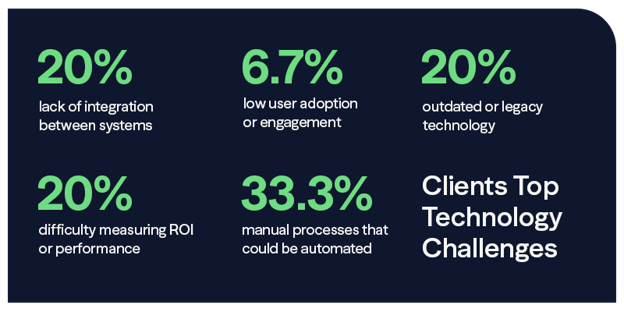
Aligning technology goals with business objectives and streamlining processes maximizes results. This process begins with strong data.
To support faster, smarter decisions, your data infrastructure must be secure, scalable, and unified:
- Standardize company-wide data definitions to ensure consistency and reduce reconciliation efforts.
- Document metric logic so finance and operations aren’t working from conflicting numbers.
- Establish clear data ownership and access controls to protect sensitive data and enable accountability.
A modern integration layer unifies disparate systems without increasing technical debt. Automating tasks such as data validation, report generation, and anomaly detection reduces errors and accelerates insights. An integrated data environment also enables automated risk detection and triage, supporting rapid response and easing the burden on security teams.
Expand capacity by empowering 'power users' to provide essential backup skills outside the IT team. Trained users in self-service roles can generate high-value reports and insights, allowing technical professionals to focus on higher-value tasks.
Why Visibility Matters in the Age of AI
AI is advancing organizational progress. Gartner predicts that by 2029, explicitly modeled business decisions will be five times more trusted and 80% faster than ungoverned decisions. Additionally, over one in ten organizations will be AI-first by 2030.
Yes, AI is the way of the future, but only if it’s built on a solid foundation:
- AI cannot fix fragmented data.
- Poor visibility equals poor AI outputs.
- AI not tied to business goals will ultimately fail.
Most AI initiatives fail because businesses are not prepared. As a result, 57% of C-suite leaders feel their company is not fully ready for AI adoption, and only 36% have scaled generative AI solutions.
Organizations with connected systems deploy AI more quickly and achieve better strategic outcomes than those without integrated systems.
From Insight to Ongoing Performance
Visibility creates value only when it drives sustained action. High-performing organizations manage profitability through integrated data, real-time insights, and continuous adjustment.
This includes:
- Performance Intelligence, which uses AI-driven and automated systems to collect real-time data and surface predictive insights. Rather than simply reporting what happened, it helps leaders understand what may happen next and what to do about it.
- Performance Visibility, provides leaders with a real-time view of operational, financial, and strategic performance, helping teams align priorities and act on opportunities faster. IBM found that the main barrier to AI adoption is how organizations adapt their people, processes, and culture.
- Performance Management, which emphasizes continuous feedback and flexible goal setting. Research shows that CEOs who revisit strategic priorities at least quarterly are better positioned to pivot during disruption.
The result is a high-performing organization that operates cohesively, adapts quickly, and improves continuously. These practices foster an agile, high-retention environment grounded in shared purpose and transparent data.
Eide Bailly brings finance, operations, and technology perspectives together to help middle-market organizations strengthen visibility and profitability. Unsure where to begin? Download the CFO Tech Planning Toolkit to help you understand the impact of visibility and a strong data foundation.
Frequently Asked Questions
Why do organizations struggle to turn data into decisions?
Many organizations struggle to turn data into decisions because information is fragmented across systems, metrics are defined inconsistently, and reporting is often delayed. Without a shared source of truth, leaders spend more time validating data than acting on it. High-performing organizations prioritize data quality, governance, and accessible insights so decision-makers can move quickly and confidently.
What data is needed for AI initiatives?
Successful AI initiatives depend on trusted, accessible, and well-governed data. Organizations need consistent financial, operational, customer, and performance data that is integrated across systems. Before implementing AI, leaders should focus on improving data quality, standardizing definitions, and eliminating information silos to ensure accurate and reliable outputs.
What leading indicators should executives monitor?
Executives should monitor leading indicators that signal future performance, including backlog, capacity utilization, forecast variance, inventory turns, customer retention, workforce productivity, cash conversion cycles, and pipeline activity. Unlike historical financial results, these indicators help organizations identify risks and opportunities before they affect profitability.
How do high-performing organizations use real-time data?
High-performing organizations use real-time data to continuously monitor business performance, make informed decisions, and adapt quickly to changing conditions. Rather than relying solely on historical reports, they use integrated dashboards, automated analytics, and predictive insights to improve operational efficiency, strengthen forecasting, manage risk, and drive sustained profitability.
What does data visibility mean for business profitability?
Data visibility refers to having real-time, accurate, and consistent access to operational, financial, and performance data across the organization. When leaders can clearly see how the business is performing, they can identify inefficiencies, respond to issues sooner, and make informed decisions that improve margins and cash flow.
How does real-time data improve decision-making?
Real-time data allows organizations to move from reactive to proactive decision-making. Instead of relying on outdated reports, leaders can monitor performance as it happens, adjust forecasts quickly, and respond to changes in demand, costs, or risk before they impact profitability.
Do organizations need new systems to improve data visibility?
Not always. Many organizations can significantly improve visibility by optimizing existing systems, integrating data sources, and standardizing definitions. In some cases, targeted technology investments are needed, but the biggest gains often come from better alignment, governance, and automation.
How does visibility and profitability fit into middle market readiness?
In the middle market, visibility and profitability are foundational to readiness. Clear insight into margins, cash flow, and unit economics enables better decisions before growth, capital, or transition. Without visibility, profitability becomes reactive — and readiness breaks down when complexity increases.
Why are visibility and profitability harder to manage in the middle market?
Middle market companies face enterprise level complexity without enterprise level resources. Systems evolve organically, reporting lags decision making, and leaders wear multiple hats. As a result, visibility and profitability are harder to maintain — yet more critical as the business scales.
How can finance and operations align around performance?
Finance and operations align when they use shared metrics and a common view of business performance. Connecting financial results to operational drivers improves forecasting, decision-making, and profitability.

Our outsourcing advisors will work with you to improve operations and increase performance.
Create a lasting digital future for your organization.
Who We Are
Eide Bailly is a nationally ranked accounting and advisory firm bringing financial, operational, and technical solutions to middle market and high-growth organizations.