
Key Takeaways
- Risk has moved from a back-office to an operational issue. As automation, connected systems, and AI expand, risk now appears in data, workflows, and decision-making, rather than just in compliance reviews.
- Strong controls drive better performance. Construction leaders use governance, quality data, and embedded controls to improve forecasting, protect margins, and enable fast, confident decisions.
- Resilience comes from visibility and alignment. Construction companies should connect finance, operations, and technology around consistent data, clear ownership, and practical oversight to turn risk into an advantage.
Construction leaders have always managed risk. However, today, the pressure is no longer limited to safety incidents, contract terms, or year-end compliance. It is increasingly tied to how construction companies operate day to day: through their systems, data, workflows, and automation.
As contractors modernize, adopt AI, and connect more tools across the business, the nature of risk begins to shift. The stakes are no longer just regulatory; they directly affect margin, cash flow, and the ability to scale. Poor controls, inconsistent data, or weak governance now affect forecasting accuracy, project execution, billing, cash flow, cybersecurity, and margin.
That is why leading construction companies now view risk as a core business performance issue.
Why Risk Looks Different in Modern Construction
Construction firms are investing in digital tools to improve visibility, efficiency, and execution. But without integration and standardization, these investments often create more complexity.
Outdated ERP and project systems continue to create inefficiency and errors. Research shows that 39% of specialty contractors use spreadsheets, whiteboards, and other manual methods rather than construction-specific software solutions.
At the same time, project and financial data remain fragmented across jobsite tools, payroll systems, accounting platforms, spreadsheets, and disconnected applications. Procore research found that 18% of project time is lost searching for data, and 28% is wasted due to rework.
Cyber exposure is also expanding. Jobsite tablets, drones, cloud platforms, mobile apps, and third-party connections all widen the attack surface. As cyber threats continue to rise, the potential industry loss is projected to exceed $1.2 trillion.
For construction leaders, this means risk is no longer just something to review after the fact. It is embedded in how the business runs.
Why Digitalization Isn't Enough
Construction hasn’t lagged due to lack of technology, but because its tools won’t integrate. Disconnected systems require teams to re-enter data, reconcile spreadsheets, and make decisions without clear visibility.
Instead of upgrading systems strategically, you add tools reactively, patch over gaps, and rely on staff to fill them. Manual tracking, disconnected claims workflows, and multiple platform logins lead to delays, errors, and lost revenue. Worse, they make it harder to scale operations efficiently or respond to changing workforce dynamics.
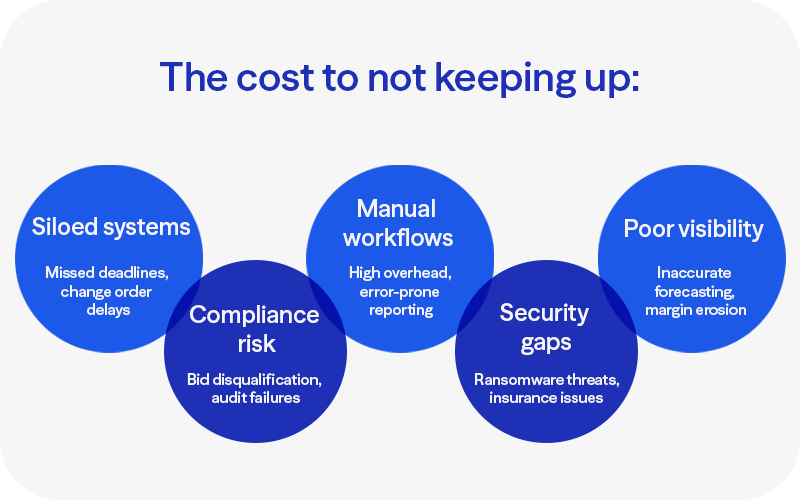
Leading construction companies operate differently. They identify issues earlier, coordinate resources more effectively, and make proactive decisions based on reliable data.
Digitalization increases speed — but without governance, it also increases exposure.
Where Construction Firms Are Most Exposed Today
The most pressing risks for construction firms are not isolated. They build on each other.
Technology Debt
Many firms still use outdated systems that require manual workarounds, duplicate data entry, and disconnected reporting, forcing teams to re-enter information, reconcile spreadsheets, and decide without real visibility.
That kind of technology debt frustrates teams, limits scalability, increases error rates, and makes automation harder to trust.
Data Risk
Fragmented data remains one of the most persistent barriers to performance. When finance, operations, payroll, and project systems each hold part of the story, you never have a reliable view of what is happening across the business.
This affects more than reporting. It undermines forecasting, weakens accountability, and makes it harder to identify issues before they impact project outcomes.
Cybersecurity and Access Risk
Cyber risk in construction is expanding as firms adopt AI, connected equipment, cloud platforms, and integrated jobsite technologies.
Vendors, subcontractors, and third-party systems introduce additional access points, increasing exposure to data breaches, payment fraud, and operational disruption when controls are inconsistent.
In more advanced environments, attacks can disrupt access to field systems or connected equipment, bringing parts of a jobsite to a standstill and directly impacting project continuity, payment processes, vendor relationships, and cash flow.
Compliance and Tax Complexity
Construction firms continue to operate in an environment of certified payroll requirements, OSHA rules, public contract obligations, tax complexity, and increased scrutiny around documentation and reporting.
Strong compliance programs can materially reduce violations and associated costs. This is not just about avoiding penalties. It is about maintaining eligibility, protecting financial credibility, and reducing disruption.
Talent and Execution Strain
Labor shortages and uneven system adoption increase the risk that critical processes depend too heavily on individual knowledge. AI-driven insights can optimize tasks such as scheduling and workforce allocation, but only when companies have the right processes, data quality, and controls in place.
Why Governance Matters More as Automation Grows
Automation increases speed. But without governance, it can increase exposure just as quickly. That is especially true in construction, where firms are trying to automate field reporting, payroll inputs, invoice workflows, project documentation, analytics, and forecasting.
If the underlying data is inaccurate or the process rules are inconsistent, automation simply scales the problem.
The same is true for AI.
Our 2026 Construction Industry Outlook found that 21% of leaders cited security and governance as one of their top AI adoption concerns, alongside data quality and uncertainty about where to begin.
After all, AI can improve visibility, identify anomalies, automate repeatable tasks, and support better decision-making. But it can only do that responsibly when the data behind it is clean, connected, and governed.
That is why construction leaders are asking:
- Can we trust the data this process depends on?
- Are ownership, access, and validation clearly defined?
- Do we have governance in place to support scale?
- Are our controls aligned to how work actually gets done?
- Dive Deeper: AI in Construction: Why Visibility Drives Real ROI
What Leading Construction Companies Do Differently
The construction leaders turning risk into a competitive advantage are building a strong operating foundation.
1. They Treat Controls as Enablers, Not Obstacles
In high-performing construction companies, controls are built into workflows, including:
- Standardized approval logic
- Clear segregation of duties
- Automated validation rules
- Role-based access controls
- Integrated audit trails across systems
2. They Prioritize Data Integrity
Forecasting, project visibility, and automation are only as strong as the data behind them.
Construction leaders should focus on:
- Consistent job cost structure
- Standardized reporting definitions
- Clean handoffs between field, operations, and finance
- Reduced spreadsheet dependency
- Strong ownership for critical data elements
3. They Embed Governance into Modernization
The strongest companies build governance into new systems and processes from the beginning by asking:
- Who owns the data?
- Who can change it?
- How is it validated?
- How is it monitored?
- What happens when an exception occurs?
4. They Align Finance, Operations, and Technology
Risk grows when each function solves problems independently. It shrinks when leaders align around shared outcomes, common metrics, and connected workflows.
This is especially important in construction, where operational decisions quickly become financial outcomes.
When finance, operations, and technology work from a common control and data framework, the business becomes easier to scale, forecast, and defend.
Real-World Example: Fragmented Systems Hide Process Inefficiencies
Here’s how hidden inefficiencies often surface when systems and teams aren’t aligned. One client needed help with invoice delays and vendor confusion. But the real issue wasn’t just in AP:
- Invoices were delayed by missing purchase orders and inconsistent shipping information.
- Over 50 purchasing card users and a decentralized approach created chaos in the approval process.
- Lack of oversight led to missed pricing opportunities and limited vendor accountability.
By centralizing purchasing, standardizing processes, and activating an ERP module they already owned, the client:
- Automated vendor onboarding.
- Streamlined invoice approvals.
- Improved visibility and vendor management.
- Reduced manual work across departments.
How Risk Becomes a Competitive Advantage
For construction leaders, resilience is not just about responding well when things go wrong.
It is about keeping the business steady under pressure:
- with cleaner reporting
- fewer disruptions
- stronger financial alignment
- clearer decisions heading into the next phase of growth
That means asking the right questions:
- Where do gaps or exposure still exist?
- Are our results, risks, and obligations aligned?
- What needs attention for priorities to move forward?
As modernization accelerates, governance becomes more important — not less. Companies gaining a competitive edge are not just adopting technology; they are also leveraging it. They are strengthening controls, improving data integrity, and embedding accountability into how work gets done.
How do you prioritize security in construction decision-making? Watch our on-demand webinar to find out more.
Learn more about our services and how we can help your business with various risks.
Frequently Asked Questions
Why is risk management changing in construction?
Risk management is changing because construction leaders are relying more on connected systems, automation, AI, and digital workflows. That means exposure increasingly shows up in data, technology, access, and process design — not just in traditional compliance reviews.
Why do controls matter more when firms automate processes?
Controls matter more because automation increases speed and scale. If the underlying data or process is weak, automation can spread errors faster instead of reducing them. Strong controls help ensure automation improves performance rather than increasing risk.
How does data quality affect construction performance?
Poor data quality undermines forecasting, slows decision-making, weakens reporting confidence, and makes it harder to identify problems early. Stronger data integrity helps construction firms improve visibility, protect margins, and support better decisions.
What are the biggest modern risk areas for construction firms?
Key areas include technology debt, cybersecurity, fragmented data, compliance complexity, and labor or execution strain. These risks are increasingly interconnected and often affect margin, project performance, and growth capacity at the same time.
How can governance improve ROI from technology and AI?
Governance improves ROI by making technology more usable, trusted, and scalable. When data ownership, validation, access, and oversight are clearly defined, firms can automate and apply AI with more confidence and less rework.
What are the top cyber risks for construction companies?
Ransomware, business email compromise, unsecured jobsite technology, and subcontractor access are the biggest cyber threats for construction firms.
How can construction firms turn risk into a competitive advantage?
Companies that prove strong controls, cybersecurity, and compliance gain better bid opportunities, lower insurance costs, and stronger financial credibility.
Where do we start with digitalizing construction operations?
Begin with a workflow and data audit, then select integrated platforms that reduce manual handoffs and errors.
Is cloud migration too risky for construction firms?
Not with the right safeguards; invest in security baselines and staff awareness to reduce exposure.
Rely on the trusted expertise of construction advisors to help you build a solid financial future.
Who We Are
Eide Bailly is a nationally ranked accounting and advisory firm bringing financial, operational, and technical solutions to middle market and high-growth organizations.