

Key Takeaways
- Automation succeeds when it improves visibility, workflow repeatability, and scalability, not when it’s treated as a tool purchase.
- Manufacturers are increasing investment in core systems, cybersecurity, analytics, and automation, signaling that data and control are prerequisites to effective automation.
- The strongest ROI comes from removing manual work across finance, operations, and supply chain while enabling skilled labor to focus on higher-value tasks.
Manufacturers are facing several challenges, including high employee turnover. Automation can help generate cost savings, improve work environments, and drive efficiency and productivity gains.
According to our 2026 Mid-Market Manufacturing Outlook, companies are automating processes with machine upgrades, modernizing core business systems, and adding new technologies, such as robotics and artificial intelligence.
Here’s the reality: automation isn’t about adding tools. It’s about removing friction so people can focus on higher-value work and the business can scale.
Automation-Enabled Growth
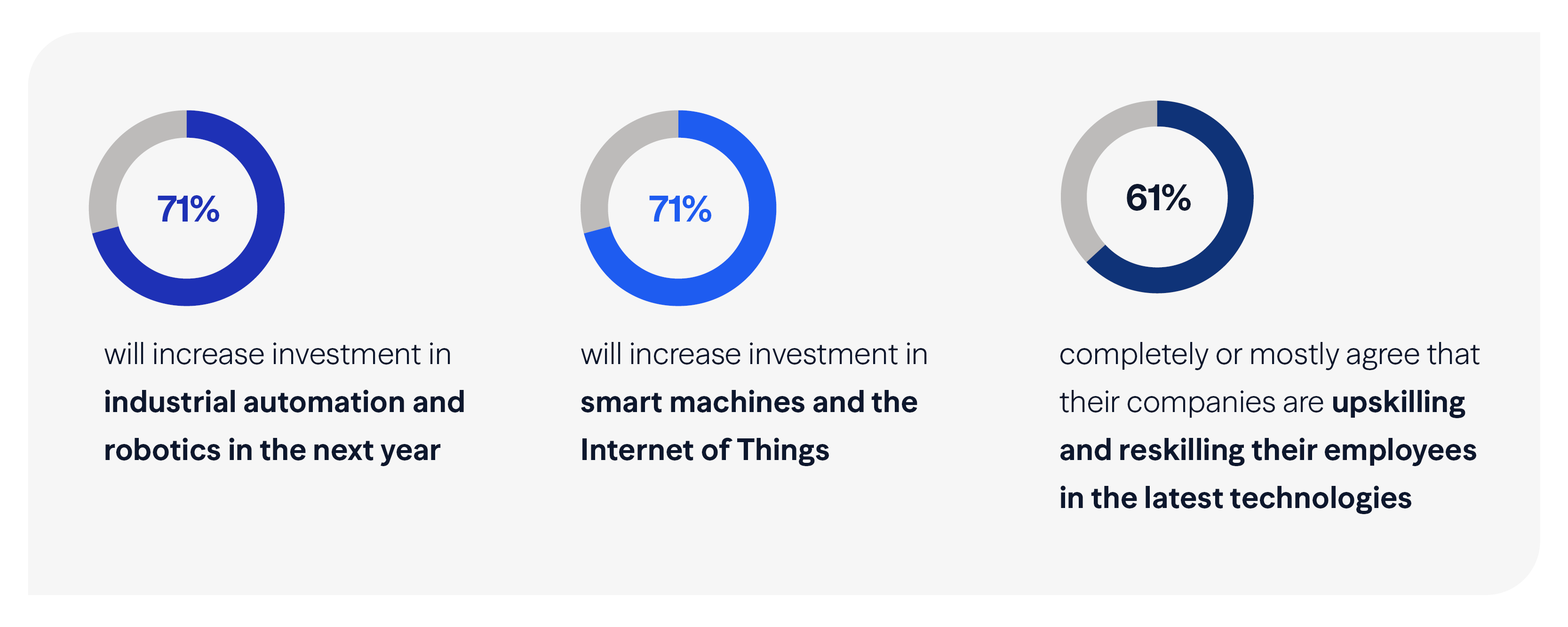
More than 70% of companies plan to increase their investments in smart machines and Internet of Things (IoT) devices. At the same time, sensors, measurements, and other technologies are being integrated into AI applications, enabling near-real-time data collection and analysis to provide early alerts and machine learning outcomes.
Automation delivers the strongest returns when it improves three things at the same time:
- Visibility: real-time insight into inventory, production, costs, and performance
- Workflow: standardized, repeatable processes that reduce manual effort and errors
- Scale: connected systems and automation that can grow without adding proportional headcount
This is how manufacturers reduce unit cost, shorten downtime, and improve the work environment—without losing the value of skilled labor.
Automation in Action
One sign that automation is working is when the business can handle higher volume without adding proportional labor. In a recent engagement, Skin Script replaced manual processes, improving inventory cost visibility and enabling better planning.
Together we:
- Replaced manual processes in accounting, sales, shipping, and order picking with automation
- Replaced QuickBooks with a modern ERP system integrated with a new WMS, instead of using manual spreadsheets
- Tripled order volume with no new hires
- Improved agility to respond to market changes and scale efficiently
The company also increased visibility into inventory costs, improving production and financial planning.
Assessing Automation Opportunities
Automation opportunities are present throughout your facilities, equipment, and operations. Look for:
- Safety improvements
- Capacity expansion opportunities
- Slow or manual workflows
Use cases for automation and AI in manufacturing include:
- Forecasting consumer demand shifts driven by tariffs or other factors
- Monitor machine usage time and maintenance schedules
- Improving demand planning and forecasting to reduce stockouts
- Creating dynamic inventory optimization
For example, one wholesaler struggled with disconnected systems. Our AI and automation solutions:
- Stabilized and optimized Microsoft Dynamics 365 Business Central
- Transitioned the organization from Azure Synapse to Microsoft Fabric for streamlined analytics
- Customized warehouse automation initiatives
- Integrated Dynamics 365 Sales and Shopify in a single day
Automation in Action: Supply Chain
Supply chain disruption remains one of the most persistent risks manufacturers face. Volatile demand, supplier instability, rising transportation costs, and SKU complexity all put pressure on inventory levels, service performance, and margins.
Rather than automating isolated tasks, high performing manufacturers focus on connecting systems and workflows end to end. The goal is not speed for its own sake, but better decisions made earlier, before disruptions cascade into missed shipments, excess inventory, or expedited freight costs.
Manufacturers that invest in supply chain automation effectively prioritize:
- Real time visibility into inventory, work in process, and supplier status
- Faster, more accurate planning, driven by integrated data rather than spreadsheets
- Reduced manual intervention, freeing teams to focus on exception management instead of routine reconciliation
Work With Us
It’s time for manufacturers to ask: do we have the systems and talent in place to act on data in real time? The answer may very well be found in automation opportunities that will streamline efficiency and enhance workforce productivity.
Connect with our manufacturing advisors today to discover how data-driven strategies, advanced technology solutions, and industry expertise can help your business optimize efficiency, minimize risk, and stay ahead of disruption.
Contact Eide Bailly Manufacturing Advisors | Access the 2026 Manufacturing Outlook Report
Frequently Asked Questions
What manufacturing processes should be automated first?
Manufacturers see the strongest returns when they start by automating high volume, repetitive processes that create bottlenecks or limit visibility. Common starting points include inventory management, order processing, warehouse operations, and data reconciliation across core systems like ERP and WMS.
How do manufacturers prioritize automation projects for ROI?
Successful manufacturers prioritize automation based on business impact rather than technology availability. This includes evaluating where automation can reduce manual work, improve data accuracy, increase throughput, or mitigate operational risk—especially in areas tied to cost, service levels, and cash flow.
How does automation help address labor shortages and turnover?
Automation helps manufacturers reduce reliance on manual, repetitive tasks while enabling skilled employees to focus on higher value work. By improving workflows and reducing operational friction, automation can improve productivity and support growth without requiring proportional increases in headcount.
How does automation improve supply chain visibility and performance?
Automation improves supply chain performance by providing real time visibility into inventory, work in process, and demand signals. Integrated systems and automated workflows enable faster planning decisions, better inventory optimization, and improved responsiveness to supply disruptions.
How do manufacturers measure automation success?
Automation success is measured through operational and financial outcomes, not tool adoption. Common indicators include reduced unit costs, improved inventory turns, increased throughput, reduced downtime, better data accuracy, and improved service performance.
How does automation support long term manufacturing growth?
When implemented with discipline, automation supports scalable growth by improving visibility, standardizing workflows, and enabling faster, more informed decision making. This allows manufacturers to grow volume, expand product lines, or adjust supply chain strategies without adding disproportionate cost or risk.

Rely on the trusted expertise of manufacturing advisors to help you build and execute your strategic vision.
Empower your team with AI and automation solutions built for growth. Unlock your full potential.
Who We Are
Eide Bailly is a nationally ranked accounting and advisory firm bringing financial, operational, and technical solutions to middle market and high-growth organizations.