
Key Takeaways
- CMS proposes a 2.4% payment-rate increase for both OPPS and ASC services in 2027, although other policy and budget-neutrality changes could significantly affect the actual financial impact.
- The proposed 340B methodology would reduce payment for acquired drugs to ASP minus 33.4%, while increasing payment for non-drug OPPS services and exempting certain rural and specialty hospitals.
- Hospitals and ASCs should assess the effects of proposed changes to the inpatient-only list, ASC covered procedures, site-neutral payments, and prior authorization requirements.
On July 2, 2026, the Centers for Medicare and Medicaid Services (CMS) issued the Calendar Year 2027 Medicare Hospital Outpatient Prospective Payment System (OPPS) and Ambulatory Surgical Center (ASC) Payment System Proposed Rule. While the proposed payment update remains consistent with recent years, CMS proposes several significant policy changes affecting hospital outpatient reimbursement. These include proposed reductions to 340B payments, expansion of site-neutral payment policies, and the continued phase-out of the inpatient-only list.
Payment Rate
The rule includes a 2.4% increase to both the OPPS and ASC payment rates. This is consistent with last year and is based on a market basket increase of 3.2%, reduced by a 0.8 productivity adjustment. The payment rate will be reduced by 2% for hospitals and ASCs that fail to comply with applicable quality reporting requirements.
CMS estimates an aggregate payment increase of $9.5 billion from 2026 OPPS payments and an increase of $520 million from 2026 ASC payments. However, the distribution of OPPS aggregate payments will be significantly impacted by some of the other proposed changes.
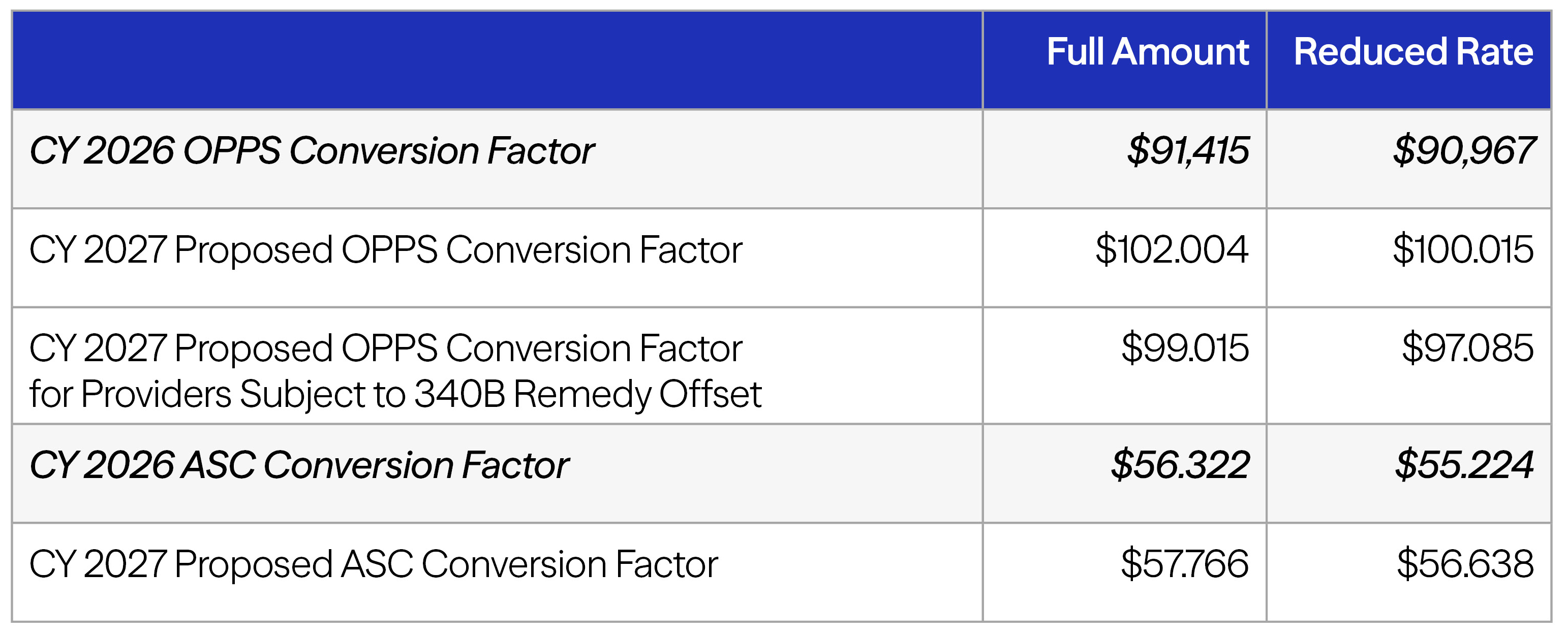
Below are the proposed conversion factors for providers that meet quality reporting requirements (Full Amount) and those that do not (Reduced Rate). These rates do not reflect the impact of any sequestration adjustments, which are discussed in the next section.
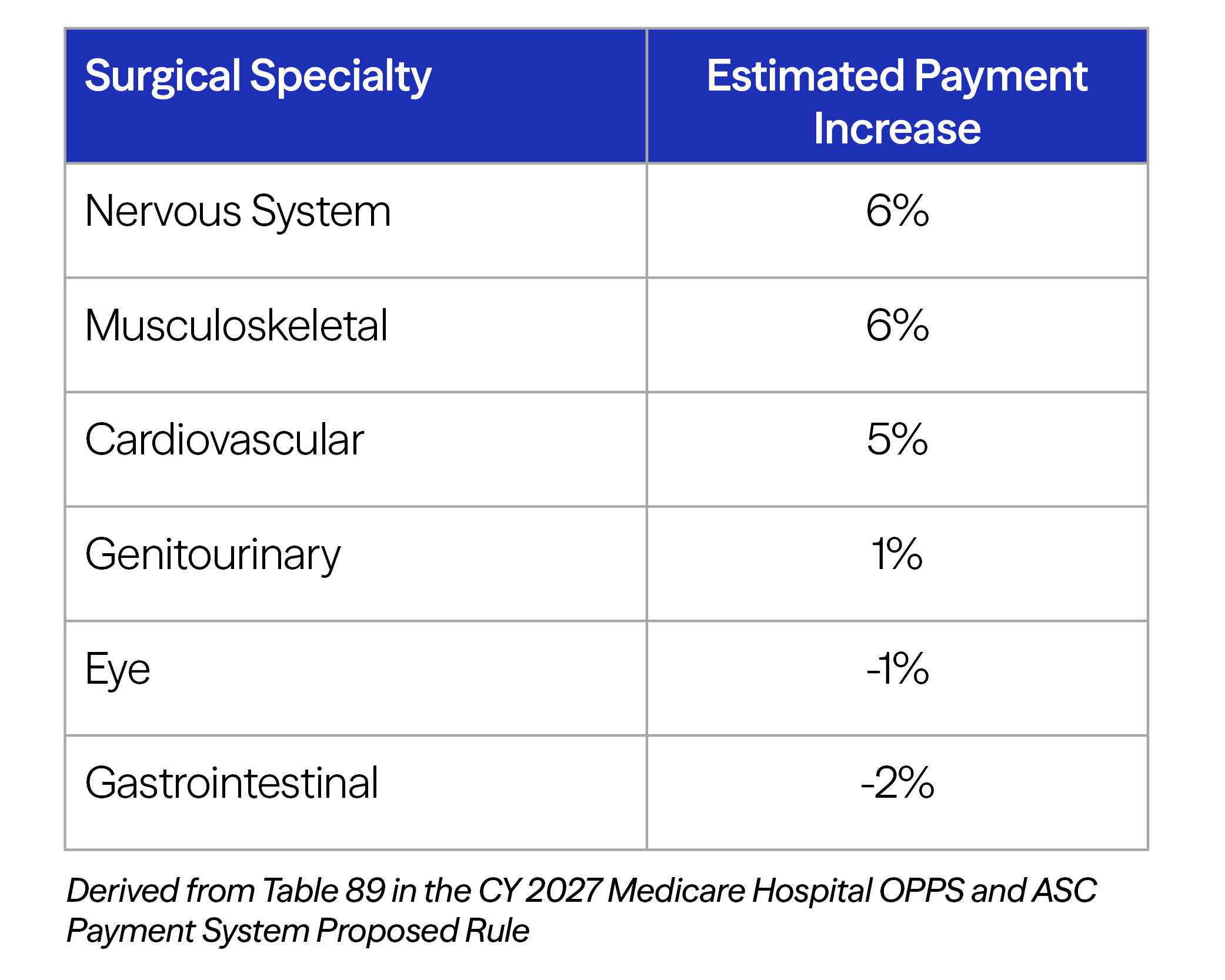
CMS estimates that the overall impact of the ASC payment updates will differ depending on the specialty:
The proposed rule also provides the expected payment changes for the 30 ASC procedures receiving the highest estimated aggregate Medicare payments in 2026.
Sequestration Impact
It should be noted that the payment rates reflected in the OPPS/ASC proposed rule are prior to any sequestration reduction. Sequestration is a required across-the-board spending cut resulting from three budget enforcement rules:
- The Statutory Pay-As-You-Go Act of 2010 (PAYGO)
- The Budget Control Act of 2011 (BCA)
- The Fiscal Responsibility Act of 2023 (FRA)
Only the sequestration stemming from the BCA is currently in effect, and it will impact Medicare payments through fiscal year 2032. Under this law, cuts to Medicare benefit payments cannot exceed 2%. The sequestration adjustment only applies to the portion of the payment made by Medicare and excludes the patient share.
PAYGO requires spending cuts across the federal government if legislation enacted in a given year increases projected budget deficits. PAYGO cuts to Medicare benefit payments would be capped at 4%. However, neither PAYGO nor any subsequent legislation includes details on how the two sequesters would be implemented together.
The One Big Beautiful Bill would have triggered PAYGO in 2026 without additional Congressional action. However, Congress passed subsequent legislation that effectively cleared the scorecard, preventing PAYGO payment cuts.
The FRA sequester applies to discretionary funding and can be triggered if applicable budget enforcement rules are broken. Since the Medicare program is funded by both mandatory and discretionary spending, any FRA sequester could impact Medicare. However, this sequester would affect only the discretionary components of the Medicare program, such as administration and fraud-investigation activities. Payments to providers for services rendered to Medicare beneficiaries would not be impacted.
340B-Acquired Drug Payment Methodology
Following completion of a hospital acquisition cost survey conducted earlier in 2026, CMS proposes paying 340B-acquired drugs at Average Sales Price (ASP) minus 33.4% beginning in CY 2027, including 340B drugs furnished by non-excepted off-campus provider-based departments. CMS states that survey results demonstrated substantial differences in acquisition costs between 340B and non-340B drugs and that this proposal would better align Medicare payments with hospitals' acquisition costs. Because the proposal must be budget-neutral under statute, CMS would increase payments for non-drug OPPS services by an equivalent amount.
Specifically, the conversion factor for OPPS non-drug items and services is proposed to increase by 8.44% for 2027. However, the proposed rule states that “for most 340B providers, the decreased 340B drug payments will outweigh the increased payments for non-drug services.” CMS estimates the 340B payment change would result in a reduction in Medicare drug payments of around $4.55 billion in the initial year, plus approximately $1.15 billion reduction in beneficiary copayments.
Importantly, CMS proposes that rural sole community hospitals, children’s hospitals, and PPS-exempt cancer hospitals would be exempted from the new 340B payment policy. Instead, these providers would generally continue to be reimbursed based on ASP plus 6%. Critical Access Hospitals and Rural Emergency Hospitals would also be exempt from the proposed 340B payment adjustment.
While the change would be generally positive for rural and non-teaching hospitals, major teaching hospitals would take a significant financial hit. However, even among rural hospitals, there is a significant disparity: sole community hospitals are expected to receive a 5.7% increase (due to an exemption from the new 340B payment policy), while other rural hospitals are expected to remain relatively unchanged from current levels.
Remedy for the 340B-Acquired Drug Payment Policy
In 2018, CMS changed its methodology for determining payments for outpatient drugs acquired through the 340B program. The change in methodology resulted in a significant decrease in payments to hospitals. The Supreme Court later ruled that the payment rates paid by CMS in 2018 and 2019 were inappropriate, as the Department of Health and Human Services (HHS) did not have the authority to vary payment rates among groups of hospitals without a survey of the hospitals’ acquisition costs. A survey was not conducted until 2020. Accordingly, CMS must make hospitals whole for the pay cuts they experienced in 2018 and 2019, which were around $1.6 billion annually in aggregate.
The 2024 OPPS and ASC final rule adopted an approach in which CMS would make lump-sum payments totaling around $9 billion to each of the approximately 1,700 hospitals affected by the inappropriate payments. Notably, CMS maintained its position that the remedy has a statutory requirement for budget neutrality. To accomplish this, CMS decided to reduce future payments for non-drug items and services. After proposing a 2% reduction in the OPPS conversion factor starting in 2026 and continuing until the full $7.8 billion budget neutrality adjustment is offset, CMS backed off in response to comments. Instead, the final rule for CY 2026 adopted a remedy offset adjustment of just 0.5%, resulting in a longer recoupment period estimated at 16 years.
The proposed rule makes a significant change to this approach by applying a 3% payment reduction to the conversion factor each year beginning in 2027. CMS estimates that increasing the 340B remedy offset from 0.5% to 3% will reduce payments for affected providers by approximately $2.3 billion in 2027.
CMS believes the accelerated recovery better aligns repayment with the hospitals that benefited from the original remedy payments and would complete the recovery of the $7.8 billion budget neutrality adjustment by CY 2029.
Changes to IPO & ASC Covered Procedures Lists
CMS plans to continue the three-year phase-out of the Inpatient Only (IPO) List. For 2027, the proposed rule would remove 637 services from the IPO, which represents about half of the services currently remaining on the IPO List. CMS expects the remaining services to be removed in CY 2028.
The services proposed for removal in 2027 include several clinical families:
- Auditory
- Digestive
- Endocrine
- Female genital
- Hemic & lymphatic
- Integumentary
- Male genital
- Maternity care & delivery
- Mediastinum & diaphragm
- Respiratory
- Urinary
In addition, the proposed rule would add 618 codes to the ASC-CPL for 2027.
Site Neutrality
Beginning in 2027, CMS proposes paying for imaging without contrast services furnished in excepted off-campus provider-based departments at the Physician Fee Schedule equivalent rate rather than the OPPS rate. This proposal builds upon prior CMS policies affecting clinic visits and, more recently, drug administration services. Rural Sole Community Hospitals would be exempt from this policy. The proposed change is estimated to reduce Medicare spending by $260 million in 2027, reduce beneficiary premiums by $70 million, and reduce beneficiary cost-sharing by around $70 million.
According to CMS estimates, there is not expected to be a tremendous disparity between provider types, with most hospital types receiving a reduction in payments of around 0.5% or less overall because of this policy change.
Alaska & Hawaii COLA
CMS proposes establishing a cost-of-living adjustment (COLA) for outpatient hospitals in Alaska and Hawaii to recognize higher nonlabor costs, aligning OPPS policy with the inpatient prospective payment system (IPPS). The proposal is subject to budget neutrality requirements, funded through a 0.9993 adjustment to the national OPPS conversion factor, and is projected to increase payments to Alaska and Hawaii hospitals by approximately $55 million in CY 2027.
Prior Authorization Expansion
CMS proposes expanding the Hospital Outpatient Department (HOPD) prior authorization process to include eight additional botulinum toxin (commonly known as Botox) injection codes beginning July 1, 2027. CMS states the proposal is intended to reduce unnecessary increases in service volume.
Overall Impact of Proposed Changes
The proposed changes and associated budget-neutrality adjustments result in significant disparities among providers based on their circumstances.
The American Hospital Association (AHA) released a statement noting “we are deeply concerned about CMS’ continued assault on the 340B drug pricing program, including its proposal to reduce 340B reimbursement rates by a shocking 33.4%.” The statement also expressed concern regarding the expedited clawback period for the 340B remedy as well as the expansion of site-neutral payment provisions.
Meanwhile, the Ambulatory Surgery Center Association (ASCA) noted that “despite the inflation update, this proposal would actually reduce payments for the most common procedures that ASCs perform.” While supportive of the proposed additions to the ASC Covered Procedures List, particularly four hernia codes, “the great majority of these procedures will still be performed in the hospital for the foreseeable future.”
Our specialized healthcare industry experts can help you understand the impact of this ruling and what to do next. Let’s talk.

We focus on the business of your healthcare organization so you can focus on your patients.
Who We Are
Eide Bailly is a nationally ranked accounting and advisory firm bringing financial, operational, and technical solutions to middle market and high-growth organizations.