

Key Takeaways
- A new OECD report notes that countries are continuing to use VAT and other consumption taxes on digital transactions.
- This is occurring alongside the U.S. pushback on digital services taxes.
- Australia also unveiled a novel way to try to capture more income from nonresident online companies.
- Tax experts worry OECD further complicating minimum tax.
- EU expecting windfall from carbon tax.
A new report from the Organization for Economic Cooperation and Development highlights how countries are continuing to look for ways to raise revenue through the digital economy—including through the value-added tax.
According to the OECD’s annual report on national tax policies, a trend towards applying VAT on digital transactions by non-resident companies is continuing. The report also notes that these practices are in compliance with new international guidelines.
Aside from entirely digital transactions, the report also stated that countries are “leveraging digital platforms and marketplaces to facilitate compliance and strengthen VAT collection,” including by applying VAT on low-value imported goods at the point of sale, rather than when the goods arrive at customs.
These trends are occurring along-side the persistent use of digital services taxes on online companies—although the difference between the two can sometimes be blurry. Unlike VATs, a DST is applied only on a select group of activities, which has been the principal complaint from U.S. tech companies. But, despite the Trump administration’s threat to use retaliatory tariffs against DSTs, only a handful of countries have repealed theirs.
The OECD report serves as a reminder that, as the term “digital economy” increasingly becomes redundant, countries are exploring more and more ways to capture online transactions. Even if DSTs were to be repealed, countries are finding other ways to capture income earned from users in their markets.
Another example, outside the VAT sphere, came from Australia this week. In an unprecedented move, the Australian Taxation Office announced Friday that it considers online streaming and other cloud-based services to be a transfer of intellectual property, thus requiring a royalty payment to an Australian entity. The ruling gives the ATO new leverage to tax online service providers earning income in Australia without a physical presence.
As with DSTs, this is sure to be challenged by tech companies if not the Trump administration–but it shows yet again that they’re both engaged in a game of Whack-A-Mole.
Noteworthy Items This Week
“The very strong perspective of the business community is that the OECD should be spending every waking moment trying to figure out how to make the rules simpler,” said Pat Brown, a co-leader at PwC’s Washington National Tax Services Practice. “Instead, they are apparently working on a package that is going to make the rules more complicated.”
Steffie Klein, counsel at Dutch tax firm Loyens & Loeff, said the Pillar Two rules already address abusive arrangements to an extent, so it begs the question about whether anti-avoidance rules aren’t needed.
She added that in her personal opinion, no matter how many rules the OECD introduces to make the global minimum tax rules airtight, “there will always be room to maneuver.”
Carbon Border Tax, E-Waste Likely Revenue Streams for EU Budget – Saim Saeed, Bloomberg Tax ($):
Other proposals from the European Commission, including a digital services tax, a tobacco excise, and a corporate tax, face broad opposition, the country said in a Sept. 4 note seen by Bloomberg. The note was circulated before a meeting of EU ambassadors Tuesday.
DAC6 Carveout for Pillar 2 Firms Remains Contentious – Elodie Lamer, Tax Notes ($):
According to the presidency's proposal, the assessment would take into account countries' experiences with the implementation of the pillar 2 directive and the OECD model rules, “including the interaction between those rules and the risk assessment information received by Member States on reportable cross-border arrangements” and relevant international developments.
The Crypto Market Structure Bill, DeFi, and Money Laundering – Lee A. Sheppard, Tax Notes ($):
The most interesting and appalling aspect of the bill is its attempt to bring only some crypto activity under the federal know-your-customer (KYC) and AML rules. The bill would still allow decentralized finance (DeFi) protocols to escape regulation and AML controls on the theory that they are free of human control and controls at the level of other players will address money laundering. This article evaluates those parts of the 616-page bill, which seems designed to obscure what is really going on..
In two opinions issued Aug. 31, the US Court of Appeals for the Federal Circuit said the Internal Revenue Code and US treaties with Canada and France unambiguously preclude offsetting the NIIT by a foreign tax credit for income taxes paid in those countries.
Finding the treaty provisions in both disputes materially identical, the court reversed two US Court of Federal Claims decisions, leaving the estate of Paul Bruyea and Matthew and Katherine Christensen ineligible to offset foreign tax credits against the NIIT.
.
Public Domain Superhero of the Week
Every week, a new character from the Golden Age of Comics, who’s fallen out of use.
This week’s entry: The Blue Flame
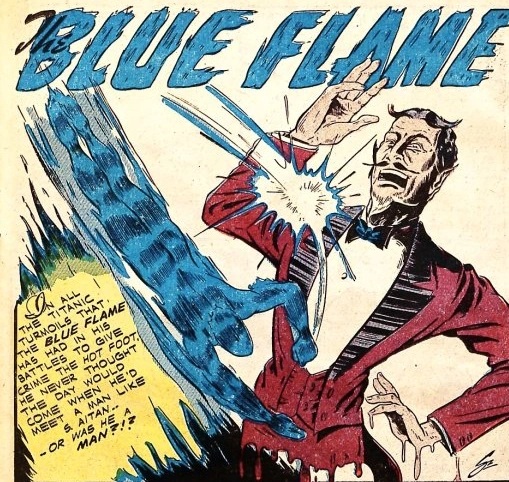
Debut Year: 1947
Debut Publication: Captain Flight #11
Origin Story: Unclear--he only lasted one issue.
Superpowers: Flight, and he can burst into flames.
Eide Bailly's International Tax Team and our affiliates at HLB, The Global Advisory and Accounting Network, stand ready to assist with your worldwide tax needs.