

Key Takeaways
- In a packed week before lawmakers left town, the Ways and Means Committee approved a bill to update the tax rules on cryptos.
- The bill addressed many issues, but also left out some of the most difficult questions.
- They could take up the bill during the lame duck session, but they’ll have a busy agenda.
- Voters are souring on the landmark GOP tax bill.
- Republican permitting reform bill to include tax relief.
In college, I never worked as hard as I did right before a break.
That sometimes happens in Congress, too. Right before heading off on the campaign trail, the House Ways and Means Committee had a productive week, approving several pieces of legislation, including two tax-related bills. One of those was a long-anticipated update to the tax rules regarding cryptocurrencies and other digital assets.
Of course, this is only one step in the legislative process. And it sets up a lot of work for what’s looking to be a very busy lame duck session in November and December.
The crypto tax bill, the Digital Asset Tax Certainty Act, includes several provisions aiming to make the rules smoother for crypto holders. These include a de minimis exemption on transaction and networking fees, as well as for designated “stablecoins” tied to U.S. currency—making everyday purchases with cryptos easier. The bill also clarifies several areas of ambiguity in the current law, which its supporters say will provide parity with non-digital assets.
One issue the bill doesn’t fully address is the question of when to tax income earned through “mining,” the creation of new cryptocurrencies, and “staking,” part of the process of recording a crypto on the blockchain. Both activities can create new crypto assets for users, but there’s disagreement on whether these should be taxed immediately as compensation or upon sale as an asset. If lawmakers can come to an agreement on this tricky issue by the end of the year, it could still make it into the final bill.
Ways and Means passed the bill with a bipartisan 38-5 vote, but there were some strong dissents. Rep. Lloyd Doggett, D-Texas, one of the opponents, claimed it was full of “new tax breaks and loopholes for the crypto industry.” That opposition could grow as the bill works its way through Congress. (The Senate recently failed to advance the CLARITY Act, adding new rules for crypto markets.)
Ways and Means also unanimously passed legislation on fraudulent use of electronic filing identification numbers (EFINs), what are used by tax preparation firms when they file on someone’s behalf. The bill requires the Internal Revenue Service to do extra verification of an EFIN before allowing it to be used. The bill is one of many small tax administrative items with overwhelming bipartisan support that have been moving through Congress—four of which were passed by the full House of Representatives last week.
That’s another package that lawmakers could deal with during the packed final session this year—when they’ll also need to consider film tax credits, a year-end extenders bill, and a potential partisan tax bill. And a bill to keep the government funded into 2027.
Recent Tax Pieces:
Trump’s Signature Tax Bill Is Starting to Bite Before the Election – Audra D.S. Burch, The New York Times ($):
But to partially offset its largess, which totals more than $3 trillion, the law also cut social services, including Medicaid, health care subsidies and food assistance, known as the Supplemental Nutrition Assistance Program. How voters view the law depends largely on which side of the federal ledger they find themselves — recipients of tax cuts or beneficiaries of programs that have been cut.
“This legislation touches everything,” said Ashley Whitlock, a substitute teacher from Belmont, N.C., who lost her SNAP benefits in the summer. “If it doesn’t impact you, it impacts someone you know.”
Fuel Producers Would Get Tax, Permitting Relief Under GOP Bill – Kellie Lunney, Bloomberg Tax ($):
The bill aims to ease supply deficits and higher fuel prices through emergency measures, if the Energy Secretary determines the US is experiencing a domestic oil and gas supply shortage. The legislation would institute several flexibilities for producers during a 180-day “supply shortage” period, including tax benefits and relief as well as reduced royalty rates and other payments to the federal government.
Charitable Tax Incentives May Need Update, Economist Says – Kelsey Brooks, Tax Notes ($):
“If so few of the major donors are individuals, shouldn’t we think more deeply about the deductibility of donations from the corporate tax system, or the excise taxes, or payout conditions that we place on foundations and DAFs, when we’re thinking not about what gets given, but what gets received?” Karol asked.
Elinor Ramey of Lowenstein Sandler LLP added, however, that the vast majority of charitable giving in the United States goes to churches and religious organizations, “and that is completely outside any of this data because they do not file 990s.”
Jon Voight Spent Months Courting Trump on Tax Help for Hollywood – Lucas Shaw, Bloomberg Tax ($):
Not long ago, a federal tax credit seemed impossible. Democratic presidents had been reluctant to look as though they were giving tax breaks to movie stars. Republicans weren’t going to reward an industry that largely didn’t support them. Legislation was never seriously discussed.
This movement may still go nowhere. But, for the first time, figures in both Hollywood and Washington say they are optimistic. That’s thanks to an unlikely bipartisan coalition of lobbyists, producers, moguls, and politicians and a president who was a former reality TV star.
How a Hedge Fund Manager Spun Up Trump Accounts in Record Time – Warren Rojas, Tax Notes ($):
Sen. Ted Cruz, R-Texas, and President Trump helped turn Gerstner’s idea into law, although the savings plans, which rocketed from legislative draft to law of the land in less than two months, could have borne a different name had Democratic leaders embraced the proposal.
While it’s too early to gauge whether the nascent tax-deferred investment program, enacted as part of the One Big Beautiful Bill Act, will convert low-income families into lifetime savers or it just becomes another tax shelter for the 1 percent, the results likely won’t materialize for decades.
Public Domain Supervillain of the Week
Every week, a new villain from the Golden Age of comics, who's fallen out of favor.This week's entry: The Son of the Skull.
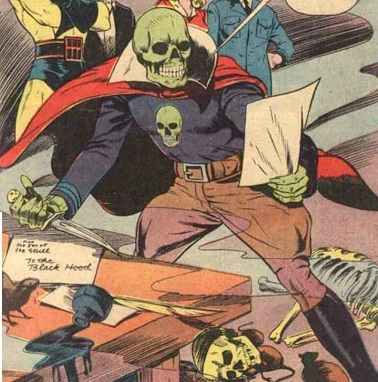
Debut Year: 1942
Debut Publication: Jackpot Comics #6
Arch-nemesis: The Black Hood (see November 26 post)
Abilities:Son of the executed crime boss The Skull, he inherited his father's cunning and ruthlessness.
Evil Plan: He's sworn revenge against Black Hood, who apprehended The Skull.