
Key Takeaways
- Insurers are proposing another year of premium hikes for the Affordable Care Act state exchanges.
- The increases are partially due to the expiration of enhanced premium tax credits at the end of 2025.
- Even with the hikes, it’s unclear if Congress will act to address the situation.
- Tips deduction promises are confusing recipients.
- The Trump administration launched Trump Accounts.
Despite dominating the political discussion in D.C. last winter, the issue of tax subsidies for healthcare plans has fallen off the radar for most of this year.
The initial shock of premium increases seemed like it could force lawmakers to reach across the aisle and make an agreement. But when the year went on, it appeared that those struggling to make insurance payments—especially through the Affordable Care Act exchanges—would not receive any additional help from Congress.
However, a recent study reported by KFF Health News underscores how this is an issue which is continuing to escalate. The report found that Obamacare enrollees can expect another year of double-digit increases in premiums. The estimate is based on proposals that insurance companies are required to submit by July 15.
The increase is despite the fact that insurance subsidies aren’t expected to change between 2026 and 2027. Unlike the end of last year, credits aren’t set to expire in the coming months. But the expiration of enhanced premium subsidies—which were first enacted in 2021—on Dec. 31, 2025 is still affecting the insurance markets, and likely will for the foreseeable future.
Due to those enhanced subsidies, enrollees above the 400% poverty level received assistance covering premium payments. After that support was withdrawn, some left the exchanges altogether, leaving a risk pool that is overall less healthy and costlier to cover than before. That causes premiums to rise again, which could prompt more to leave the exchanges again—a dynamic that health experts call the “adverse selection death spiral.”
Will the increased costs prompt DC lawmakers to action? Right now, they have a lot on their plate. Congress is working on appropriations, a cryptocurrency regulation bill (along with a cryptocurrency tax bill), and another potential Republican spending bill. They may not have bandwidth for much else. But the demand to address the rising cost of living–which healthcare plays a significant part of–may give them an incentive to act.
There’s also still a question of how to respond. While Democrats prefer a direct reinstatement of the tax subsidies, Republicans have been pushing for support through tax-favored flexible spending accounts. Those reflect very different philosophies about how to reform the healthcare system. But some Republicans crossed over to support compromise plans on premiums, and there remains some room for flexibility.
Recent Tax Pieces:
Check, Please: Workers React to ‘No Tax on Tips’ One Year In – Trevor Sikes and A.J. Collins, Tax Notes ($):
But introducing a directed education initiative and clear guidance examples about the deduction that are aimed at tipped workers could go a long way in resolving confusion and alleviating many of the headaches that taxpayers, employers, and tax professionals face, according to observers.
Trump Rings Wall Street Opening Bell, Hails Trump Accounts – Courtney Subramanian, Bloomberg Tax ($):
The Oval Office ceremony marked the first time the two exchanges have rung the opening bell together from the White House, demonstrating how financial and corporate leaders have embraced the initiative — as well as its importance to Trump’s midterm messaging, as he seeks to convince voters he is addressing cost-of-living concerns.
Trump Accounts Risk Missing Low-Income Families Buying In – Macon Atkinson, Bloomberg Government ($):
Some warn the accounts would disproportionately benefit White, middle- to upper-class families — who are more likely to already have generational wealth — if Congress doesn’t adjust the program.
“You may not have the financial sophistication to figure out how to do a Trump Account,” said Sen. Ruben Gallego (D-Ariz.), who has introduced a bill that would automatically enroll newborns into a permanent program renamed “American Dream Accounts.”
IRS Pressed to Ease Digital Asset Broker Reporting Rules – Mary Katherine Browne, Tax Notes ($):
During a July 8 public hearing on the proposed regulations (REG-105064-25) on electronic delivery of Form 1099-DA, “Digital Asset Proceeds From Broker Transactions,” under section 6045, witnesses told the government that the proposed rules’ reliance on email as the default notice channel is out of step with how digital asset customers communicate and that an all-or-nothing consent structure exposes brokers to penalties for minor, nonprejudicial defects.
Today’s AI Taxes Have a Forgotten Depression-Era Ancestor – Joseph J. Thorndike, Tax Notes ($):
But the debate is older than the technology. When Bill Gates proposed taxing robots in 2017, many leading economists dismissed the idea. Lawrence Summers called it “profoundly misguided” (Summers, “Picking on Robots Won’t Deal With Job Destruction,” The Washington Post, Mar. 5, 2017). David Autor of the Massachusetts Institute of Technology derided it as “a timelessly bad idea” (Louis Anslow, “Taxing Robots Was Suggested in the 1940s. It Was a Bad Idea Then, but Things Have Changed.,” Medium, May 18, 2017). A few experts offered tepid or qualified support, but overall, Gates’s proposal got a chilly reception. As Gregory R. Woirol observed in “The Machine Taxers,” a 2018 article for History of Political Economy, “the professional judgment was that a machine tax is a proposal with few merits.”
Public Domain Supervillain of the Week
Every week, a new villain from the Golden Age of comics, who's fallen out of favor.This week's entry: Baron Doom.
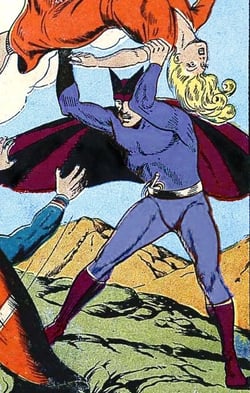
Debut Year: 1942
Debut Publication: Silver Streak Comics #19
Arch-nemesis: Captain Battle (see January 14 post)
Origin story: A wealthy baron who fought for the Germans in World War II.
Abilities: He stalks the high seas with his own special-built submarine, as well as an electric whip.