
Key Takeaways
- Sen. Warren proposed a tax on AI in a recent op-ed.
- The idea has been around for years, but data centers have given it a new target.
- It could become a prominent idea in Congress if Democrats gain control next year.
- Government watchdog to look into IRS free file program following Democratic inquiry.
- Legislative agenda for the summer still up in the air.
Sen. Elizabeth Warren, in a TIME Magazine op-ed last month, called for a new federal tax on data centers—a strong signal that taxation could play a key role in the upcoming national debates over artificial intelligence.
And, should Democrats take control of one or both chambers of Congress after the November elections, some form of tax on AI could become a reality.
“Building an economy that works for all of us will require multiple policy responses,” Warren wrote. “But it starts by acknowledging: it’s time to tax AI and invest in people.”
Of course, this isn’t the first time that someone has proposed a new AI tax. As far back as 2017, Microsoft founder Bill Gates speculated that a “robot tax” could help compensate those who become unemployed due to AI use. But the advent of data centers–necessary to perform the huge amount of data processing for chat-based AI services like ChatGPT or Google Gemini–gives the concept a more specific target.
Warren’s op-ed says that a new data center tax could be based on the amount of energy they use, which can be a significant strain on local electrical grids. Others, including billionaire entrepreneur Mark Cuban, have said that AI “tokens”—the individual pieces of data that are used in AI tasks—could be the basis for taxation. Rep. Greg Casar, D-Texas, also recently proposed a new AI tax, based on tokens, to pay for employment programs.
The idea of an excise-like tax on AI use addresses not only the overall concerns about how the technology could shape future employment—it also speaks to the growing anxiety about how fast new data centers are being constructed across the country, raising questions about water and electricity usage, among other issues. A tax on data center usage could be seen as part of a future dominated by artificial intelligence–or a way to stop that future from happening.
And while these initial proposals indicate the direction this policy could go, the progress that AI has shown in the past few years can make predicting the future near-impossible. It could be that, by the time Congress has a chance to enact any of these ideas, the situation with AI, data centers and the economy could be completely different.
Recent Tax Pieces:
GAO Agrees to Scrutinize Free File Tax Return Program Again – Ben Valdez, Tax Notes ($):
The GAO’s investigation will serve as an update to its April 2022 report on the program, which recommended that the IRS work with the Free File Alliance to make the program more accessible and “work with relevant stakeholders to identify and develop additional options for free online filing of tax returns that would reflect current guidelines for federal digital services.”
Summer Tax Agenda to Hinge on GOP’s Bill Package Plan: BGOV Tax – Kay Steiger, Bloomberg Tax ($):
If Senate Majority Leader John Thune (R-S.D.) and House Speaker Mike Johnson (R-La.) are serious about pursuing such a plan, it could derail several bipartisan initiatives that have been quietly gaining steam.
Trump Audit Immunity Deal Puts Pressure on IRS to Execute – Erin Slowery, Bloomberg Tax:
“It’s so unprecedented that it’s just something that I don’t know how this is going to be executed,” said Nina Olson, former longtime National Taxpayer Advocate who’s now executive director of the Center for Taxpayer Rights. Olson signed onto an amicus brief filed in the case urging the judge to examine the conflict of interest.
Styling Crypto Taxation and Market Structure – Lee A. Sheppard, Tax Notes ($):
When we last visited crypto market structure, two things were holding up legislation. The first and most important was the battle between the banks and the crypto bros about whether stablecoins, which have been enabled by the Guiding and Establishing National Innovation for U.S. Stablecoins (GENIUS Act) (P.L. 119-27), can pay yield. The second was the impropriety of the Trump family and associates dabbling in crypto ventures other than silly meme coins.
Opinion: No Wonder Everyone’s Rallying Around This Terrible Idea – Natasha Sarin, The New York Times ($):
Public Domain Supervillain of the Week
Every week, a new villain from the Golden Age of comics, that's fallen out of favor.This week's entry: The Purple Peril.
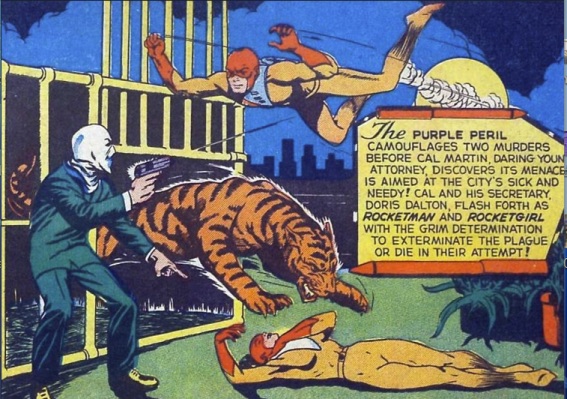
Debut Year: 1946
Debut Publication: Punch Comics #18
Arch-nemesis: Rocket Man (see June 2 post)
Origin story: Unknown—he preys on the weak in while wearing a hood.
Abilities: No superpowers, but in his crimes he's assisted by his pet tiger.