

Key Takeaways
- Extension isn't a failure. It might be the winning move.
- How it can save time and money.
- 2022 refund window is closing.
- Tax wish list for a reconciliation bill.
- Tariff trickery.
- Preparer gets 12 years for ERC and tax fraud.
- National Chicken Little Awareness Day.
Running Out Of Time Before Tax Day? An Extension Might Be Your Best Move - Kelly Phillips Erb, Forbes:
Extensions can be a smart move. They give you time to gather documents, double-check complicated transactions, and avoid the kind of last-minute filing mistakes that can cause problems.
...
But extensions are not a completely free pass. Don’t just file for an extension and start rushing again in October. Take the extra time to get organized, gather your documents, and reach out for professional help if you need it.
Stop Fearing Tax Extensions: Why Buying Time Can Actually Save You Money - Manasa Nadig, The Buzz About Taxes:
...
The IRS itself tells taxpayers who need more time to file to request an extension rather than rush a return. Using the extra months deliberately often produces a more accurate, more tax‑efficient result than scrambling in March or early April.
Take the time you need to get it right. It's cheaper to do a return right once than to do a wrong return and then fix it.
The 2022 Refund Window is Closing
Refund Statute Closing Soon on Unfiled 2022 Returns - Thomas Gorczynski, Tom Talks Taxes. "While it is best to file any 2022 Form 1040 returns before April 15, 2026 to avoid issues, many individuals may qualify for an exception that allows for a full or partial refund if the original 2022 return is filed after that date."
If Wishes Were Legislation
Taxwriters Eye Wish List for Possible Reconciliation 2.0 - Cady Stanton, Tax Notes ($):
Miller [Max Miller, R-OH, Ways and Means Member] said he’d like to see his framework for taxing digital assets included in reconciliation conversations, along with reversing the cap on the gambling tax deduction that the Senate added to the OBBBA. Both ideas have bipartisan backing.
Others, including Hern, have pointed to partisan health care tax provisions that were stripped out of the House version of the OBBBA because of the Senate parliamentarian, including individual choice health reimbursement arrangements and expansions on tax-advantaged health savings accounts.
The article also says taxwriters would like to work in a corporate minimum tax reduction, but many members think it will be difficult to get any reconciliation bill passed, let alone one with significant tax provisions.
Lobbyists Prepare for Republicans’ Next Partisan Budget Push - Kate Ackley, Bloomberg ($):
Lobbyists see opportunities.
...
Stacy McBride, executive VP of federal government affairs at HB Strategies, said she’s lost count of how many times she’s explained the reconciliation process to clients this week.
She said this one will look different than last year’s OBBB with a much narrower aim, though it will depend on which congressional committees get involved.
New York lawmaker seeks SALT expansion if House pursues tax bill - Nacha Cattan and Erik Wasson, Bloomberg via MSN:
Representative Nick LaLota, a Republican from Long Island, is trying to extend that threshold past five years, when the cap is expected to revert back to $10,000. He said he wants to make changes to secure more benefits related to the SALT deduction if the GOP’s spending bill involves modifications to the tax code.
Tax Enforcement Thursday
Justice Department Makes More Tax Enforcement Changes - Nathan Richman, Tax Notes ($):
Acting Attorney General Todd Blanche described the new division’s mission and the initial steps contributing to its formation in an April 7 memo.
“The core mission of the National Fraud Enforcement Division is to zealously investigate and prosecute those who steal or fraudulently misuse taxpayer dollars,” the memo says. The Justice Department also immediately moved the Criminal Division’s tax section; the Market, Government, and Consumer Fraud Unit; and the Health Care Fraud Unit under the purview of the new assistant attorney general for the division.
The old Tax Division of the Justice Department has been shuttered, with its staff reassigned within the department.
Donor-Advised Funds in the News
The Tax-Saving Charity Funds Wealthy People Are Buzzing About - Miriam Gottfried, Wall Street Journal:
...
Provisions in the new law affected people who itemize their deductions—typically a wealthier group than those who take the standard deduction. It created a new floor on the deduction for charitable contributions. Starting this year, charitable donations below 0.5% of adjusted gross income won’t be deductible.
Take someone who makes $1 million a year and has committed to giving $10,000 a year to charity over the next four years. Under the new rules, that person wouldn’t be able to deduct $5,000 of their 2026 donation. To counter that, the strategy for 2025 was to pull future donations forward and take a bigger onetime deduction. If this person instead donated $40,000 to a DAF at the end of 2025, they could take the full deduction, with the DAF distributing the money to the charity over the next four years.
Related: Eide Bailly Wealth Transition Services.
Tariff and Trade Thursday
‘Definitely a Sham’: As Tariffs Climb, Trade Fraud and Accounting Tricks Proliferate - Ana Swanson, New York Times:
The average value of the products in a 20-foot container plunged nearly 40 percent from January 2025 to February 2026, according to data compiled by ImportGenius, a trade data provider. Yet the average value of a container headed to the United States from elsewhere in the world remained relatively flat.
The reason? Experts say companies most likely began finding ways to reduce the value of the goods they were sending to the United States. Lowering the value of the toys, couches and other products headed for America’s shores meant that companies could also reduce the amount of tariffs they had to pay for those imports.
Related: Eide Bailly Transfer Pricing Services.
Tax News & Views International Weekly: Tax Changes and the OECD Deal - Alex Parker, Eide Bailly:
Some noted, however, that there was a contradiction in the messaging. The OECD granted the U.S. a side-by-side exemption, because its current laws met the new conditions to be a “qualified SBS regime.” (Perhaps not coincidentally, the requirements closely match the current U.S. system.) It respects the decisions Congress has made—but what if Congress decides in the future to change the tax code again?
There’s a risk, however small, that changes to the tax code could run afoul of the OECD standards, void the exemption (at least in the eyes of some participants), and subject U.S. companies to Pillar Two taxes. And as the possibility of a major tax bill in 2026 rises, there’s an outside chance that lawmakers could soon face this dilemma.
Blogs and Bits
10 tax deadlines that are on April 15 - Kay Bell, Don't Mess with Taxes. "10. Submit your FBAR foreign assets to the U.S. Treasury. This is the due date for the required filing of Reports of Foreign Bank and Financial Accounts, or FBAR."
Expansion gives millions of entities access to business tax accounts - Martha Waggoner, The Tax Adviser. "The IRS has expanded the business tax account to millions of entities — including partnerships, Indian tribal governments, tax-exempt organizations, and government bodies — that did not previously have access to the online, self-service platform."
Time to Increase the Annual Gift Exclusion Amount? - Annette Nellen, 21st Century Taxation:
Another Kind of Long Covid
Tax Preparer Gets 12 Years In Largest-Ever COVID Tax Fraud - Anna Scott Farrell, Law360 Tax Authority ($):
This is an example of the kind of fraud that led to the IRS moratorium on filings and Congressional termination of the program. From the Justice Department press release (Defendant name omitted, emphasis added):
From November 2020 to May 2023, Defendant orchestrated a massive, multimillion dollar scam to exploit those COVID-related tax credits for his own greed. As a tax preparer, Defendant prepared and submitted, and worked with others to prepare and submit, more than 1,900 false employment tax returns to the IRS claiming COVID-related tax credits on behalf of himself and his clients. Each of these tax forms contained a number of false statements. For example, the vast majority of the tax forms claimed a fictitious number of employees and/or fabricated wages.
Defendant and his co-conspirators fraudulently sought more than $170 million in tax refunds on behalf of his own businesses and his clients and successfully caused the government to pay out over $55 million in refunds.
Throughout the scheme Defendant also charged clients a percentage of the refund checks as his fee and requested cash payments. He failed to report the money he received from his clients, thereby evading his own taxes.
Shocker that he didn't report taxable income from fraud.
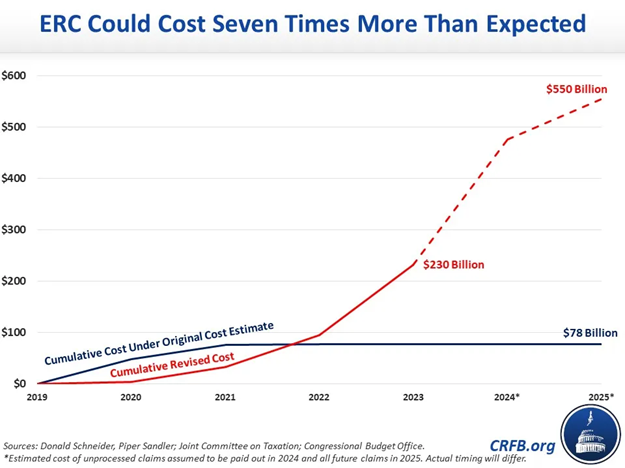
The massive fraud associated with the program wasn't taken into account when Congress set it up. The Committee for a Responsible Federal Budget noted this in 2024:
While original scores put the cost of the ERC at about $78 billion, it may end up costing over $550 billion – seven times the initial deficit impact – and mostly go to businesses who do not need it to retain workers or survive the pandemic.
You probably remember the commercials.
As usual: legislate in haste, repent at leisure.
What day is it?
It's National Chicken Little Awareness Day! Sometimes it feels like that little bird was on to something.