

Key Takeaways
- Refunds are quick for perfect filings. Otherwise, not so much.
- Senate GOP cuts tax provisions out of Reconciliation 2.0.
- About that study saying 88 profitable corporations pay no tax.
- US Federal Taxes are still progressive.
- UK's high wage taxes.
- The hidden brackets of welfare systems.
- National Jelly Bean Day.
While Trump Touts Tax Cuts, Some Americans Wait for Their Money - Chris Cioffi, Bloomberg:
For those willing to give bank information, that was their chance to fix the problem. But taxpayers without a bank account or those unwilling to give that information are in for a potential wait to get any paper refund they’re entitled to.
...
Taxpayers who in years past would have received paper checks by default now received a letter—often sent by mail—from the IRS asking for direct deposit information or another digital payment option. The letter gives them 30 days to provide a bank account number via the agency’s website, and includes a phone number sending callers to a recording that, among other options, refers callers to the IRS website.
The letter didn’t mention that taxpayers could call and request a paper check or that, according to an online factsheet, giving no response will result in an automatic paper check after six weeks.
Senate Reconciliation Omits Tax Provisions
Senate GOP Leaders Leave Tax Out of Reconciliation 2.0 - Katie Lobosco and Cady Stanton, Tax Notes ($):
The reconciliation bill would end the partial government shutdown by funding Immigration and Customs Enforcement and Customs and Border Protection for 3 1/2 years, according to the budget resolution the Senate advanced with a procedural vote April 21.
...
Despite their disappointment, the taxwriters stopped short of saying they wouldn’t support the narrow reconciliation package.
“People understand that we have to get Homeland funded,” Smucker said, referencing the Department of Homeland Security.
Sure He Threw 30 Touchdowns, but Look at His Batting Average
Did 88 Corporations Really Pay No Income Tax on Billions of Profits? - Adam Michel, Liberty Taxed:
But the report’s headline claim is simply wrong. The profits and taxes in ITEP’s headline come from two different accounting systems, built for different purposes, reporting to different audiences, using different rules.
Adam explains the mechanics:
Under current tax law, the firm can deduct the full $10 million in the year the investment is made. The firm’s taxable income in 2025 is zero, but it will have no additional deductions left over in future years.
ITEP’s method would report that this hypothetical firm earned $9 million in profit and paid zero federal income tax. In reality, it spent every dollar it earned investing in new manufacturing capacity. Its economic profits and taxable income match; they are both zero.
Blaming companies for not paying enough tax on accounting income is like criticizing quarterbacks for not hitting any home runs.
Taxes Burdens Here and Abroad
After Pandemic Relief Ended, CBO Shows Federal Taxes Remained Progressive in 2022 - Garett Watson and Emily Kraschel, Tax Foundation:
Income has grown at the bottom of the scale:
While incomes have risen for the bottom 20 percent, their federal tax rates have fallen to close to zero:
The top 1 percent, on the other hand, saw an effective tax rate of 31.2 percent from 2010 to 2019. It hovered around 30 percent through the pandemic years, close to the 1979-2000 average federal rate of 30.5 percent for the top 1 percent of households.
UK taxes on wages rose more than in any other rich country in 2025, says report - Valentina Romel and Delphen Strauss, Financial Times:
In 2025, a single worker with no children earning the average national wage faced a UK tax burden of 32.4 per cent of labour costs.
The figure, which includes employee and employer social security contributions as well as income tax and subtracts any cash benefits received by working families, was up 2.45 percentage points compared with 2024, according to the organisation’s report published on Wednesday. This marked the largest rise across all 38, mostly industrialised, members of the OECD.
Related: Eide Bailly Global Mobility Services.
Tax The Rich Tax Creep
Cut hours and avoid promotions: how the £100,000 tax trap is shaping work - Chris Newlands, Financial Times, on how a tax on "the rich" moved down market in the UK:
For most people it would have been a time for celebration. But for the mother of two it was distressing as the payment would have nudged her income above £100,000 per year, the point at which she would start to lose her tax-free personal allowance of £12,750 and forsake valuable childcare benefits.
...
Had her adjusted net income — an HMRC calculation used to determine eligibility for help with childcare costs — risen just £1 above the £100,000 threshold, she would have had to give up 30 hours per week of government-funded assistance, in her case worth more than £10,000 for each child, and her tax-free childcare entitlement, valued at £4,000 a year for her two children. The loss of the personal allowance results in a marginal income tax rate of 62 per cent between £100,000 and £125,140. “The relatively small bonus would have cost me thousands,” she says.
Like cell phone use, taxes aimed at the wealthy can move to a broader market.
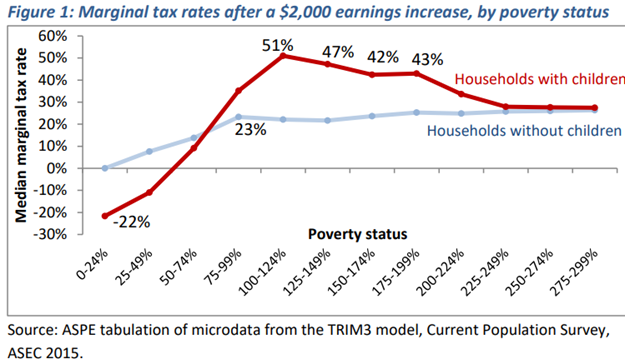
The U.S. has its own hidden tax brackets from phase-outs. The tax and welfare systems take away benefits as incomes rise, creating hidden tax brackets on low incomes.
Soy Much For That
IRS Notches Court Win Over ‘Project Soy’ Corporate Tax Maneuver - Richard Rubin, Wall Street Journal:
In a 2-1 ruling on Tuesday, the 10th U.S. Circuit Court of Appeals upheld a lower-court decision against Liberty Global’s “Project Soy,” a series of maneuvers that the company used to exploit gaps in the 2017 tax law.
The ruling bolstered the government’s use of what is known as the economic substance doctrine, a concept that Congress incorporated into the tax code in 2010. The basic idea is that companies can’t engage in tax-reducing maneuvers that lack a substantial business purpose, and the IRS has been using the doctrine to attack transactions during audits.
Link: Tenth Circuit opinion.
Related: Eide Bailly IRS Dispute Resolution and Collections Services.
When the Game is Rigged, Leave the Table
Pro poker player who’s won more than $48 million says new tax laws forced him into semi-retirement: ‘It’s really untenable’ - Ryan Ermey, CNBC:
...
But this year, he says, he plans to play maybe a quarter of the tournaments he usually plays, and virtually no “high-roller” events, which cost $25,000 or more to enter. The reason is simple, he says: taxes.
President Donald Trump’s One Big Beautiful Bill Act, which passed last July, includes a provision that changes the way gamblers can deduct losses. Taxpayers still must treat gambling winnings as income, but they can no longer use all of their losses to fully offset their winnings. Rather, starting in tax year 2026, they can only deduct up to 90% of their losses.
Blogs and Bits
Early tax holiday season in Missouri and Texas - Kay Bell, Don't Mess With Taxes. "The Lone Star State’s Emergency Preparation Supplies Sales Tax Holiday is this coming weekend, Saturday, April 25, through Sunday, April 27."
Court treats insurance policy lapse as taxable income when loans exceed value - Tax Coda. "Policy loans may seem like borrowing from yourself, but if the policy collapses, the IRS treats the wiped-out balance as income, even if you never receive any cash."
Hurry Up and Wait - Russ Fox, Taxable Talk.
I paid my tax via IRS Direct Pay (or you had my account debited). Why hasn’t my payment come out yet?
The answer to this question is simple, and there’s nothing your tax professional can do about it. The IRS can only handle so many debits a day, so many payments made for April 15th will happen in the days following April 15th. Taxpayers need to allow up to ten business days for their payment to post. It’s usually much less, but we’ve seen it take that long.
Sometimes You Should Just Pay The Tax
U.S. Expatriate Pleads Guilty to Evading Tax on Hedge Fund Income - William Hoke, Tax Notes ($):
The article gives this background:
From the Justice Department press release (Defendant name omitted, emphasis added):
According to court documents and statements made in court, Defendant managed a hedge fund focusing on cryptocurrency investments. Between 2020 and March 2022, Defendant earned a total of more than $6 million from his hedge fund but did not report any of this income on his 2020, 2021 or 2022 tax returns. Instead, Defendant falsely reported earning income of $5,000 or less during each of those years. At the same time, he held millions of dollars in foreign bank accounts that he failed to disclose to the IRS.
In November 2021, Defendant became a British citizen. He renounced his U.S. citizenship in March 2022. Individuals who expatriate from the United States are required to report certain information to the IRS about their net worth, income, assets, and liabilities as of the date of their expatriation. Defendant willfully filed a false expatriation statement reporting that his net worth was $25,000 at the time of expatriation, when in fact it exceeded $2 million, and stating that he had complied with his tax obligations for the preceding five years when he knew that he had not.
That kind of money leaves tracks.
Some sort of prison time seems likely. I have no idea what sort of advice this man received when he was doing all this, but it turned out badly. As a wise man has said, sometimes you should just pay the tax.
What day is it?
It's National Jelly Bean Day! Try them with jelly.