

Key Takeaways
- Taxpayers take their chances with a diminished IRS.
- Do you feel lucky?
- Treasury issues tip deduction rules. Santa Claus does well.
- Taxpayers have high interest in new deductions.
- Taxpayer perceptions vs. tax reality.
- Tariff refund mechanism set to go live April 20.
- International Plant Appreciation Day.
America’s New Tax Mantra: ‘The IRS Isn’t Going to Catch Me’ - Richard Rubin, Wall Street Journal:
The retrenchment is spurring a vibe shift across the tax landscape ahead of the April 15 deadline, and lawyers say they see more taxpayers and tax-shelter promoters eager to cut corners or cheat.
...
“They have defunded the police,” said Matthew Rappaport, a tax lawyer at Falcon, Rappaport and Berkman in New York. “There’s no more succinct way to describe what’s happened.”
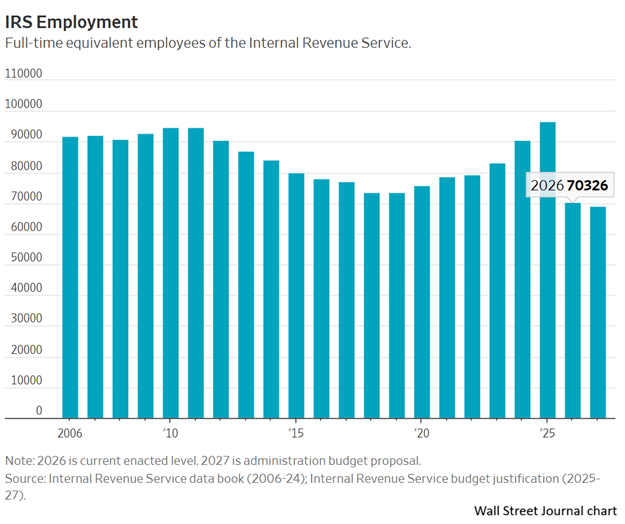
The article covers a lot of ground. A few key points:
- Several important IRS positions are job-shared. The IRS "CEO" is also the head of the Social Security Administration. The acting IRS chief lawyer is also the senior Treasury policy official. The IRS civil enforcement head, Jarod Koopman, is also running criminal enforcement.
- Mr. Koopman denies that the IRS is backing off "key areas."
- Practitioners say the IRS appeals office is overloaded.
- President Trump has pardoned high-profile taxpayers convicted of tax crimes, including the reality TV Chrisleys.
- Enforcement is cyclical, which means it can come back.
For fraudulent returns, there is no statute of limitations. Non-fraudulent returns that substantially understate tax have a six-year audit window.
So it's possible that taxpayers can get away with tax cheating, for now. Still, given the timing of elections and the breathtaking advances in artificial intelligence, would-be tax cheats should ask themselves the perennial question: "do I feel lucky?"
IRS Recalls Agents From Immigration Enforcement
IRS Criminal Investigators Pull Back From Immigration, Policing - Nathan Richman and Benjamin Valdez, Tax Notes ($):
Departing CI Chief Guy Ficco recently spoke with Tax Notes and described how the division has been assisting with the Trump administration’s nontax priorities and how those efforts are wrapping up.
...
Ficco, whose last day at CI was April 10, said that during the reassignments, CI detailed up to 250 special agents at a time to title 8 immigration case work. But for the most part, individual special agents served only about two weeks at a time on the non-core-mission detail, enabling them to keep up active work on their normal inventory of cases, he said.
The TIPS Deduction: What the New Regulations Say
Final Tips Deduction Regs Define Eligibility, Address Abuse - Trevor Sikes, Tax Notes ($):
The qualified tips deduction under section 224, enacted by the One Big Beautiful Bill Act (P.L. 119-21), allows single filers who earn up to $150,000 and joint filers who earn up to $300,000 to deduct up to $25,000 in cash tips that are voluntarily paid to the worker.
...
The final regs adopted the proposed regs’ (REG-110032-25) definition of a voluntary tip, but clarified that for a tip to be voluntary, it must be able to be reduced to zero if the payer chooses.
Also, a payment to a digital content creator is a tip only when the customer makes the payment voluntarily to the creator after already having access to their content, and the amount of the tip is determined by the customer.
IRS Releases List Of Jobs That Can Deduct Tips - Anna Scott Farrell, Law360 Tax Authority ($):
...
Public comments seemed to play a large role in making the list, prompting the agency to create separate categories for visual artists, floral designers and gas pump attendants while definitively excluding chiropractors, accountants, tax preparers and people who sell concert merchandise.
The agency found that clergy members, while they did not typically receive tips, might receive them for weddings or funerals and so could be eligible for the deduction in those cases.
IRS Has an Early Present for Santa Claus: Tax-Deductible Tips - Caitlin Reilly, Bloomberg ($):
The agency added visual artists to the list, specifically noting caricature artists and ice sculptors may deduct tipped income when they file their taxes this year. The final list also added floral designers and gas pump attendants, in a win for New Jersey, where customers can’t legally pump their own gas.
...
Final rules still left some professions out in the cold, including anyone who collects tips related to “illegal activities, pornography, and prostitution,” over the objections of some public commenters. The IRS, however, didn’t define pornography.
What to know about Trump’s tax breaks for tips and overtime when filing state tax returns - David Lieb, Associated Press:
But many people won’t get those same deductions when they fill out their state income tax forms. That is because it is up to each state to decide whether to match federal tax changes, and many have decided not to do so.
How Are the New Deductions Going Over?
Taxpayers’ Interest in New Deductions Runs High, Poll Finds - Benjamin Valdez, Tax Notes ($):
The poll, which surveyed 1,200 taxpayers who filed their taxes this year and was conducted March 23-24, found that taxpayers with tips or overtime income — more than a third of respondents — were more likely to file in January than those without the income.
...
The report estimated that the average benefit among households claiming the overtime deduction is $350 a year for those making under $75,000, compared with $2,940 for households making over $200,000.
Takeaways From BPC’s 2026 Tax Filing Season Poll - Andrew Lautz, Bipartisan Policy Center:
The poll reports that not all taxpayers realize the effect of the tax law changes on their returns:
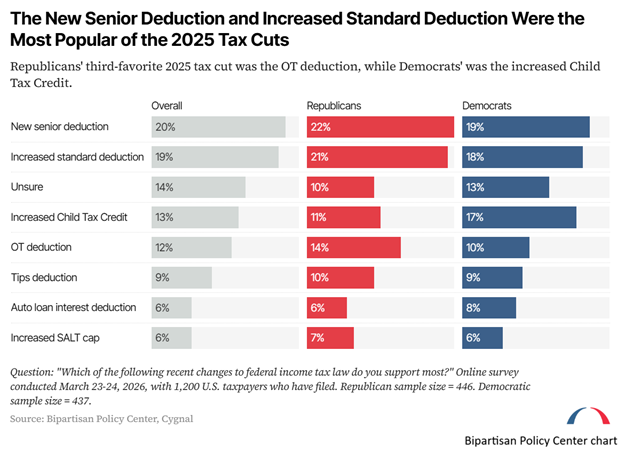
The poll also addressed the popularity of the 2025 tax cuts:
Tax Policy Perceptions
Almost 6 in 10 still say taxes too high: Gallup - Ryan Mancini, The Hill:
“Americans’ views of their taxes have remained near their most negative levels in two decades for the past three years, both in perceptions of the amount paid and whether it is fair,” the polling firm stated.
Tax Policy Reality
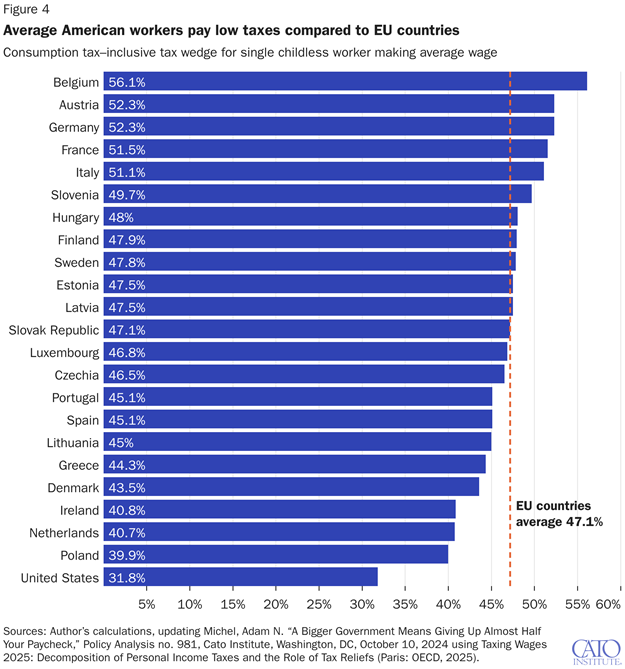
Tax Day: Five Charts on Who Pays, How Much - Adam Michel and Santiago Forster, Liberty Taxed: "The United States remains a relatively low-tax country compared to its global peers. Among 22 high-income nations in the European Union, the US ranks dead last in total tax burden (federal, state, and local) for the average single worker."
Tariffs: Refunds Ready soon? The New Tariffs in Court
First Phase Of Tariff Refund System To Launch April 20 - Anna Scott Farrell, Law360 Tax Authority ($):
The agency said the system is meant to simplify the process for recovering taxes collected by President Donald Trump's global tariff policy under the International Emergency Economic Powers Act, which the Supreme Court struck down in February.
The system — which Customs has termed the "consolidated administration and processing of entries," or CAPE — is coming online in phases. The first phase is "limited to certain unliquidated entries and certain entries within 80 days of liquidation," Customs said Friday.
Related: Eide Bailly Transfer Pricing Services.
Federal court hears new case against Trump’s latest global tariffs - Mae Anderson and Paul Wiseman, Associated Press:
...
Awkwardly for Trump, his own Justice Department argued in a court filing last year that the president had needed to invoke IEEPA because Section 122 did “not have any obvious application’’ in fighting trade deficits, which it called “conceptually distinct’’ from payments problems.
Awkwardly for the plaintiffs challenging his use of the temporary tariffs, the trade court itself wrote last year in its own decision striking down IEEPA tariffs that Trump didn’t need them because Section 122 was available to counter trade deficits.
In New Tariff Cases, Trump Asserts 'Unreviewable' Power To Invent a Balance-of-Payments Deficit - Jacob Sullum, Reason:
Blogs and Bits
Beware tax scams that are popping up as April 15 approaches - Kay Bell, Don't mess With Taxes. "Every fraudster’s goal is to get our tax and personal information. They use (or sell) it to file false returns claiming fraudulent refunds during tax season."
Bozo Tax Tip #2: Use a Bozo Tax Professional - Russ Fox, Taxable Talk. "Don’t be a bozo. If you use a tax professional, use an ethical preparer. You may pay more for your return preparation and get a lesser refund (though the refund amount should be accurate), but you will rest a lot easier."
Court Upholds OBBBA's Retroactive Prohibition of ERTC Refunds - Parker Tax Pro Library. "The court rejected the taxpayer's argument that the retroactive bar was a due process violation, finding that the provision is rationally related to the legitimate legislative purpose of preventing tax fraud."
Related: Eide Bailly Employer Retention Credit Services.
It's on YouTube, it Must be True
Social Media Influencer Gets 6 Years For $20M Ponzi Scheme - Craig Clough, Law360 Tax Authority ($):
From the Department of Justice press release (Defendant name omitted, emphasis added):
Defendant also caused the issuance and filing of approximately 14 false and fraudulent 1099-INT tax forms. He filed the IRS forms to report interest income for investors who did not earn interest. Defendant claimed he had reinvested victims’ interest earnings when in fact he had not.
Defendant admitted to misappropriating investor funds to further his lifestyle and make purchases like rental payments on a condo in downtown Columbus, frequent travel, a $150,000 Mercedes SUV and various cryptocurrency investments.
"A rate of return of thirty percent or more." If you can buy that, you can be scammed, like this guy's victims. What's worse is that some of them paid tax on fictional thirty percent investment returns. I hope they filed amended returns on time. Not everything you see on social media is true, especially about investments and taxes.
What day is it?
It's International Plant Appreciation Day! A fine day to hang out with your green and yellow buddies.