

Key Takeaways
- IRS waives 2025 estimated tax penalties for qualifying farmers and fishers.
- Slow issuance of key form made March 1 filing difficult.
- Liberation Day tariff anniversary.
- How they happened, what they did.
- The fight for tariff refunds.
- What next for tariffs.
- National Peanut Butter and Jelly Day.
IRS Relieves Farmers, Fishermen From Estimated Tax Underpayment - A.J. Collins, Tax Notes ($):
Notice 2026-24, 2026-17 IRB 1, issued April 1, is borne out of concern that some affected taxpayers may have experienced difficulty preparing and e-filing complete income tax returns including Form 8995, “Qualified Business Income Deduction Simplified Computation,” after recent filing changes.
The IRS corrected the instructions for Form 8995 on January 27, and some taxpayers reported they couldn’t complete their returns until February 23, when software updates became available.
This waiver relates to the March 1 "Farmer Deadline." Most taxpayers whose income taxes are not covered by withholding have to make quarterly estimated tax payments. Qualifying farmers and fishers get a special deal. They can either:
- Make no estimated tax payments, but file and pay by March 1 to avoid underpayment penalties, or
- Make one (reduced) estimated payment by January 15, with any balance due paid by the normal April 15 due date.
IRS Notice 2026-24 waives all estimated payment requirements for qualifying farmers who file by the normal April 15 deadline.
Every year rural tax preparers are pressured to complete farmer returns by March 1 to meet the "farmer deadline." It's not really a deadline - a farmer return filed or extended by April 15 is not subject to late filing penalties. It's just a way to delay estimated tax payments. But this is widely misunderstood. Farmers with minimal tax, or even losses, still worry that they need to meet the "farmer deadline."
It's dubious as a policy matter. Farming is a capital-intensive high-tech enterprise. Yet the tax law acts like farms are incapable of following the same payment rules as other businesses.
Even the April 15 deadline has become unrealistic for many filers with the explosion of businesses requiring K-1s and the proliferation of corrected 1099s issued well into filing season. March 1 filing is even worse.
Liberation Day, One Year After
Today is the anniversary of President Trump's "Liberation Day" press conference, where he introduced a wide array of seemingly random new tariffs on almost every country in the world, including at least one that doesn't really exist.
The Supreme Court earlier this year ruled the tariffs, allegedly authorized by the International Emergency Economic Powers Act, illegal. The president promised to reimpose tariffs using other authorities.
We devote most of today's roundup to the year in tariffs: what has happened, whether they worked, the status of refunds of the IEEPA tariffs, and where tariffs stand now.
A Year After ‘Liberation Day,’ Experts Review the Costs of Trump’s Tariffs - Council on Foreign Relations:
But the Trump administration has sealed an underwhelming amount of trade deals in the ensuing year, and Americans have often borne the knock-on effects. Although the U.S. Supreme Court struck down some of Trump’s tariffs in late February, it appears that the White House is gearing up to get their tariff agenda back on track by other means.
What Are the Tariff Results?
One Year After “Liberation Day”: Here’s What We Know and What We Don’t - Scott Lincicome, Alfredo Carrillo Obregon, and Chad Smitson, Cato at Liberty:
Safe to say, things didn’t exactly work out as promised.
Liberation Day Was One Year Ago: Did the President’s Tariff Promises Happen? - Erica York, Emily Kraschel, Tax Policy Blog:
1. These tariffs would mark the day “American industry was reborn.”
2. They would “make Americans wealthy.”
3. Reciprocal tariffs would “bring in trillions and trillions of dollars to pay down America’s debt.
4 “Jobs and factories,” he claimed, “will come roaring back.”
5. The new production enabled by the tariffs would “lower prices for consumers.”
At the height of the trade war—including the “Liberation Day” and other tariffs imposed under the International Emergency Economic Powers Act (IEEPA), plus sector-specific tariffs imposed under Section 232 authorities—the tariff rates were the highest since 1911, constituting a $3.2 trillion tax hike over a decade.
One year later, the evidence shows the tariffs were not reciprocal, did not generate the promised investment boom, raised less revenue than projected, and contributed to higher prices.
One year later, Trump has remade global trade — with mixed results - David Lynch, Washington Post:
But the chronic trade deficit, which the president that April afternoon declared a job-killing national emergency, has declined for 10 consecutive months. More than 20 trading partners yielded to the president’s tariff threats — in some cases after resisting for years — and agreed to open their markets to U.S. products. Some foreign leaders also promised generous investments in new factories that one day might employ the president’s blue-collar supporters.
This mixed picture emerged following an uneven year of policymaking. Trump’s habit of threatening tariffs over matters large and small and his tendency to water down or forget his most bellicose threats earned the dismissive shorthand “TACO,” for “Trump Always Chickens Out.”
Looking for Trump’s $18 trillion - Erica York, Supernormal Returns.
...
Everywhere we look, President Trump’s $18 trillion is nowhere to be found.
Every President Tries It. It Never Works. - Jason Furman, New York Times:
...
These forces — rising productivity but steady demand — explain why the United States was losing manufacturing job share as far back as the 1950s and 1960s, long before trade became a major factor. The downward trend changed little after the U.S. entered NAFTA in 1994 or granted permanent normal trade relations to China in 2000.
The Fight for Tariff Refunds
IEEPA Tariff Refund Process - Chad Martin, Eide Bailly:
1. Importers or their customs brokers must submit a CAPE Declaration via the new web-based portal in the Automated Commercial Environment (ACE). This involves uploading CSV files with a list of entry summaries for the IEEPA refunds.
2. CAPE will automatically remove the tariff codes from each entry and recalculate the total duties owed as if those tariffs never applied.
3. CAPE schedules a date to finalize (liquidate or reliquidate) the entries and applies interest (currently at 6% for corporations) to the final amount owed.
4. Refunds are consolidated by the Importer of Record (IOR) and paid electronically.
In an update on March 19, CBP reported substantial progress toward CAPE’s development, with mass processing the only process estimated at less than halfway complete. Further updates are expected by the end of the month.
Tariffs Put Businesses in Crisis. Waiting for the Refund Could Be Worse. - Louise Radnofsky, Lydia Wheeler and Sarah Nassauer, Wall Street Journal:
Bankruptcy is a real possibility, he said, if a refund doesn’t come by July for the $175,000 in extra tariffs he paid on imported stock for his Tampa-based luxury online retailer over the past year.
...
The $166 billion the Trump administration collected from tariffs voided by the Supreme Court amounts to the largest illegal government levy in the nation’s history. Now, almost exactly a year after President Trump declared “Liberation Day,” companies of every size are wrestling with uncertainty about when, how—and even if—they will get refunds, a process made more complicated because the federal government isn’t eager to return the ill-gotten gains.
Companies’ Tariff Refund Calculus May Change With These Factors - Elyssa Kutner, Brian Janovits and Julia Kim, Bloomberg ($). "Companies should consider adopting a “belt-and-suspenders” approach to tariff recovery. The belt consists of filing administrative protests within 180 days from the date of liquidation of an entry. The suspenders are the filing of a case at the CIT."
Tariff refund payments may take up to 45 days once system operational: Customs - Ashleigh Fields, The Hill:
...
The first wave of system claims will prioritize customs entries liquidated, or finalized, within the preceding 80 days and entries whose liquidation status has been “suspended, extended, or under review,” according to Reuters.
What Next For Tariffs?
Trump Expected to Overhaul Steel, Aluminum Tariffs - Gavin Bade and Bob Tita, Wall Street Journal:
The 25% tariff would apply to the entire value of a finished product—known derivative products—containing steel and aluminum, the people said. That would replace the current 50% duty, which only applies to the value of steel or aluminum used in a product.
The 50% tariff will remain in place for commodity-grade steel and aluminum products—goods that are almost entirely made of the metals, the people said. Some goods could be reclassified as commodity products if they are made almost entirely of the metals.
US readies new pharmaceutical tariffs - Aime Williams, Financial Times:
The levies — set to be announced as soon as Thursday — would be applied to companies that have not struck deals with the White House, said people familiar with the matter.
...
The fresh levies being announced this week are the result of a national security investigation under Section 232 of the Trade Expansion Act of 1962, which was launched in April last year.
Tariffs Return as Clock Ticks Down on Trump’s 10%: Supply Lines - Brendan Murray, Bloomberg ($):
He also launched two Section 301 investigations — one targeting industrial overcapacity and another probing forced-labor practices — that could lead to tariffs.
But unlike a year ago, the mere mention of additional import taxes seems like a tougher sell politically while inflation concerns are mounting and trade is slowing because of the US-Israeli war against Iran that has no end in sight.
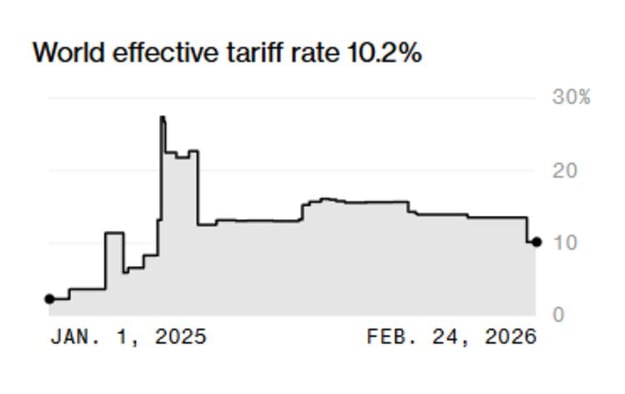
From Bloomberg Economics Tariff Tracker.
Taxes Around the World
Tax News & Views International Weekly: New Big Beautiful Revisions - Alex Parker, Eide Bailly:
The legislation, sponsored by Rep. Ron Estes, R-Kan., and Sen. Shelly Moore Capito, R-W. Va., could increase how much business interest companies can deduct under I.R.C. Sec. 163(j), which sets a limit on interest deductibility based on a company’s overall taxable income. While the OBBBA loosened the limit by allowing companies to exclude depreciation and amortization in the calculation, it also nixed some forms of offshore earnings, such as Subpart F income, from the formula as well.
Blogs and Bits
6 no-fooling tax moves to make in April - Kay Bell, Don't Mess With Taxes. "2. Get more time to finish your taxes. If you just can’t finish your return, be it by hand or electronically, by April 15, get more time. The IRS is happy to give you six more months to complete your annual tax task."
Bozo Tax Tip #8: The $0.78 Solution - Russ Fox, Taxable Talk. "So assume you have a lengthy, difficult return. You’ve paid a professional good money to get it done. You go to the Post Office, put proper postage on it, dump it in the slot (before April 15th), and you’ve just committed a Bozo act."
Home Sale, Forced To Sell Abroad? U.S. Tax Rules In Uncertain Times - Virginia La Torre Jeker, US Tax Talk. "Heightened geopolitical tensions across parts of the Middle East are prompting some expatriates to reconsider their long-term plans. For some, this may mean a rapid relocation."
Related: Eide Bailly Global Mobility Services.
Tax Man Coming up Shorts?
The IRS Chief, His Old Pal and the Case of Muhammad Ali’s Missing Pair of Shorts - James Fanelli, Wall Street Journal:
But these days the Trump administration heavyweight has something else to worry about: He’s locked in a fight over a pair of Muhammad Ali’s boxing shorts.
Eric Inselberg, a sports memorabilia buff and entrepreneur, said he gave the prized gear to his former friend Bisignano years ago as collateral for a $500,000 loan. Inselberg said he settled the debt but Bisignano has nonetheless refused to return the trunks, which he estimates are now worth $800,000.
The sports memorabilia market, like the market for fancy watches, is one I may never understand. That must be why I never get the opportunity to make this sort of collateralized loan.
What day is it?
It's National Peanut Butter and Jelly Day! Best to remember to use bread as well.