

Key Takeaways
- Refunds falling short of $1,000 promise.
- Taxpayer calls down, internet use up.
- Avoiding return filing blunders.
- Another iffy valuation shelter.
- Extender bill odds.
- SALT Madness.
- Kitten Day, Puppy Day.
Tomorrow! Tune in for Eide Bailly's Quarterly Legislative Update at noon Central Daylight Time. Alex Parker, Colette Gagnet, and Andrea Mouw will cover the waterfront from pending tax legislation to IRS guidance, highlighting planning opportunities. Register here.
Tax Season: Filings Still Lag, Refunds Up, But Lower than Advertised.
Tax Season Filings Are Catching Up, But Still Lag Behind Last Year - Kelly Phillips Erb, Forbes:
As of March 13, the IRS had received 69,707,000 individual income tax returns, compared with 70,370,000 at the same point in 2025. That’s a 0.9% drop in filings, though the gap has narrowed slightly since earlier in the season.
...
One important factor is that early filers tend to submit simpler returns—usually those claiming the standard deduction and mainly reporting wage income from Forms W-2. Returns that include business income, rental activity, or complicated itemized deductions typically come in later during the season. If that pattern holds, the IRS could still see a late-season push of more complex filings.
Tax Refunds Up, But Falling Short of Trump’s $1,000 Promise - Caitlin Reilly, Bloomberg ($):
Refunds averaged $3,623 through March 13, 11% higher than the same point last year, according to data the IRS released Friday. Nearly half of anticipated returns already have been filed.
Average refunds typically decline as the tax season progresses since people who anticipate large refunds generally apply for them sooner while those who have to pay the government tend to wait. Still, the size of refunds also could move up in the coming weeks, particularly because taxpayers may not yet change ingrained filing habits to account for new breaks.
Return Filings, Phone Calls Remain Down This Filing Season - Benjamin Valdez, Tax Notes ($):
The trend clashes with some of the agency’s initial expectations of heightened call volumes stemming from the new provisions of the One Big Beautiful Bill Act (P.L. 119-21). At the start of the filing season, the IRS lowered its phone service goals in part to give accounts management staff more time to work through an extensive return inventory backlog.
National Taxpayer Advocate Erin Collins, speaking during a March 17 event, said the decrease is indicative of more taxpayers using tools that are available on IRS.gov — which is seeing a 54 percent spike in visits this year.
Navigating the Filing Season
These Simple Steps Can Save You Time and Trouble With the IRS - Laura Saunders, Wall Street Journal:
Be sure to report this income, because the IRS systems get 1099 forms from financial institutions reporting such payouts and transfers. If the information isn’t on the taxpayer’s return, that could produce a “matching error” and a computer-generated query demanding tax.
They Want to Stop Paying Taxes as a Protest. There Are Consequences. - Tara Siegel Bernard, New York Times:
Failure to pay will almost immediately result in automatic letters from the I.R.S. Over a 10-year period — the statute of limitations for collecting unpaid debts — you can expect your tax debt to triple, Mr. Rice said. (There is no statute of limitations for false or fraudulent returns.)
How a shady tax preparer’s practices can lead to costly IRS trouble - Michelle Singletary, Washington Post:
A Long Island tax preparer pleaded guilty in January to filing false returns and faces $12 million in restitution. Her clients were charged over $1 million in fees, mainly because she took a percentage cut of the refunds she was inflating with fraudulently claimed credits and phantom dependents. In one instance, an undercover agent hired the preparer to prepare his return. He should have owed the IRS about $205. Instead, the preparer falsified a return that would have indicated a refund of more than $14,000.
Other shady practices covered include "ghost preparers" who refuse to sign the return, preparers who claim work expenses for W-2 employees, and preparers who want you to sign a blank return before they prepare it.
Taxpayers are responsible for what is on a return even if they hire a preparer. Look it over. If you see a Schedule C but don't have your own business, run away.
Another Charitable Donation Shelter Emerges
Whistleblower Targets Tax Shelter Promoting Do-Good Technology - Michael Bologna, Bloomberg:
The pitch documents don’t specify how generous, but investors in the strategy are “effectively guaranteed” they’ll be able to claim a tax deduction of five times their initial investment, according to a Senate whistleblower complaint obtained by Bloomberg Tax. In that scenario, a $50,000 minimum investment in the technology via the shell companies would morph into a $250,000 charitable deduction at the end of the tax year.
This approach raises an obvious question. If the technology is really that valuable, why are they selling it at 20 cents on the dollar to investors?
Be careful out there. This reminds me of the syndicated conservation easements that have come to grief in Tax Court.
Tax Policy: The Current Stalemate, The Future of Congressional Tax Writing Panels
Capitol Hill Recap: The Odds of Extenders - Alex Parker, Eide Bailly:
It sounds far-fetched, but there’s been more talk among lawmakers that a bipartisan extenders bill—what used to be a routine vehicle to delay the expiration of uncontroversial tax measures—could be doable this year.
...
While the pieces are there, putting them together could be difficult. Democrats are loath to help Republicans on any tax matters after the GOP shut Democrats out of the writing of the One Big Beautiful Bill Act. And with Republicans also testing the waters for another reconciliation bill, Democrats could have even more reason to stand firm in opposition.
Powerful Tax-Writing Panels to Lose Experience After Midterms - Chris Cioffi, Bloomberg ($):
It’s not just important legislative knowledge that will change, the issues that may get attention could change too.
Wars and Oil Crises Drive Tax Policy Shifts - Mindy Herzfeld, Tax Notes ($):
Or any other profits.
State and Local: Around the Legislatures; Wealth Tax Flight
SALT Madness: What's Advancing and What's Out? - Melissa Menter and Colette Sutton, Eide Bailly. "March Madness brings brackets, buzzer‑beaters, and plenty of surprises—and the SALT landscape this month is no exception. As legislative sessions wind down, several states are making last‑minute pushes to pass or amend tax legislation, with changes coming right up against the clock."
Massachusetts Loses Billions in Income After Millionaire Tax - Greg Ryan, Bloomberg ($):
The amount was an 8% year-over-year increase, according to Internal Revenue Service data, even as the total number of taxpayers leaving the state slowed.
This was the first year that residents were subject to a 4% surtax on incomes over $1 million after voters approved the levy in 2022 to fund schools and transportation.
Taxes aren't everything, but they are a thing.
Would California’s Wealth Tax Be Temporary? - Jared Walczak, Tax Policy Blog:
Temporary taxes have a way of sticking around. California’s current top rates were first adopted in 2012 as a seven-year surcharge. Voters extended the income tax increases in 2016 and will decide this year whether to make the higher rates permanent. But at least this involved going back to the voters.
Related: Eide Bailly State and Local Tax Services.
The Secret Tax Life of Big Business
Corporate America Finally Reveals (Some of) Its Tax Secrets - Richard Rubin and Theo Francis, Wall Street Journal:
Many companies that generate these credits—battery makers, wind farms, solar arrays—don’t owe enough in taxes to use them. So Congress let them sell credits to companies that can use them to lower their tax bills, creating a new market in tax breaks.
Buyers typically pay 90 to 95 cents for a dollar of tax credits. Profitable companies have grown increasingly comfortable with the market’s complexities and risks.
Related: Eide Bailly Energy Incentives Services.
Blogs and Bits
IRS’ lack of a plan to deal with taxpayer correspondence backlog could hamper other agency services - Kay Bell, Don't Mess With Taxes. "The Government Accountability Office (GAO) says the Internal Revenue Service still has a backlog of taxpayer correspondence and no plan for how to reduce it."
Americans Are Leaving U.S. At Record Pace—But Not IRS Taxes - Robert Wood, Forbes. "If you are a U.S. citizen, the fact that you live abroad—even forever—does not mean that you avoid filing tax returns with the IRS or paying U.S. taxes."
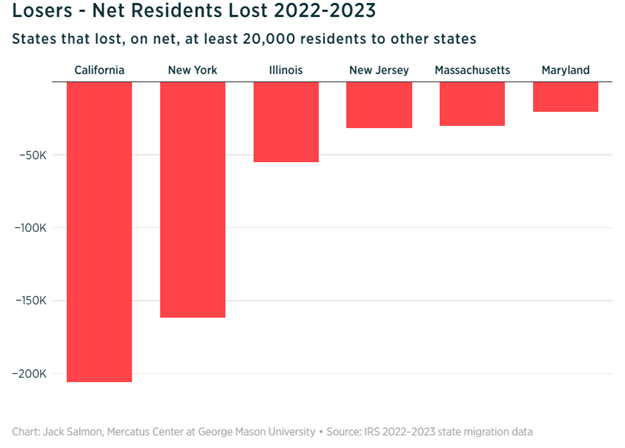
The Great American Tax Migration: State Winners and Losers in 2023 - Jack Salmon, The Unseen and the Unsaid. "California lost 205,788 residents, the largest net outflow in the country, including 37,777 high earners. They took $13 billion in income with them, $7.6 billion of that from the high-earner cohort alone."
What day is it?
It's Cuddly Kitten Day! It's also National Puppy Day. Choose wisely.