

Key Takeaways
- Tariff refund lawsuits underway.
- Administration scrambles for reasons to not pay.
- 15% tariff rate "where appropriate."
- Tariffs can't cover deficit.
- Is there another way to cover spending?
- Supreme Court ponders equity theft.
- 1099-OID scam reaches the UK.
- National Pistachio Day.
Tariff Challengers Seek Enforcement of SCOTUS Strike-Down - Caitlin Mullaney, Tax Notes ($):
...
“Throughout the case, government lawyers assured the courts that businesses would suffer ‘no harm’ during appeal because, if the tariffs were struck down, refunds would automatically issue with interest,” said the Liberty Justice Center, an organization that represents V.O.S. Selections. “Now, Administration officials have publicly suggested that refunds could take ‘weeks or months’ — or even years,” the organization said in a February 24 release announcing the motion.
“Now we are asking the courts to ensure the government honors its commitments and refunds American businesses,” Sara Albrecht of the center said in the release. “These refunds are owed to American companies that employ American workers... The rule of law requires compliance — not delay,” she said, noting that there are more than 900 related cases pending at the CIT.
Businesses Push for Tariff Refunds as Trump Aides Hint at Fight to Come - Tony Romm, New York Times:
Now that the president has suffered such a stinging defeat, major businesses including Dyson, FedEx and L’Oreal have filed an early barrage of lawsuits in search of hefty tariff payouts. But the Trump administration has responded in recent days with a mix of dismissal and derision, setting up what may be a landmark legal battle over refunds.
Trump’s next tariff fight: Keeping the money - Megan Messerly and Daniel Desrochers, Politico. "Officials across the Trump administration are scrambling to devise legal strategies that would allow the government to keep billions of dollars in tariff revenue the Supreme Court said was illegally collected."
The $130 Billion Race for Companies to Get Their Tariff Money Back - Louise Radnofsky, Lydia Wheeler, and Chao Deng, Wall Street Journal:
More companies have joined them in the days since the court’s decision, including FedEx, and lawyers are predicting a deluge of litigation to come.
“We’re talking asbestos level of lawsuits,” said Matthew Seligman, a federal litigator who is filing lawsuits for importers, referring to the thousands of lawsuits filed over decades seeking recovery for alleged injuries related to the material. But the tariff cases, he said, are “all happening at the exact same time.”
The Replacement Tariffs
Trump to Hike Tariff to 15% ‘Where Appropriate,’ Greer Says - Hadriana Lowenkron, Jonathan Ferro, Annmarie Hordern, and Lisa Abramowicz, Bloomberg News:
“So right now, as we talked about, 10% is in place. There will be a proclamation raising it to 15% where appropriate,” Greer said Wednesday on Bloomberg Television’s Surveillance program.
Greer sought to clarify how the administration would follow through on Trump’s threat to hike the rate to 15%, which added to US trading partners’ confusion in the wake of the Supreme Court’s nixing of his so-called “reciprocal duties.” A 10% worldwide levy took effect Tuesday, and in the ensuing 24 hours, the administration offered few details about how it would follow through on the president’s threat while honoring pacts with major trading partners.
Tariffs Aren't Enough
America Can’t Tariff Its Way Out of This Debt Crisis - Romina Boccia, The Debt Dispatch:
...
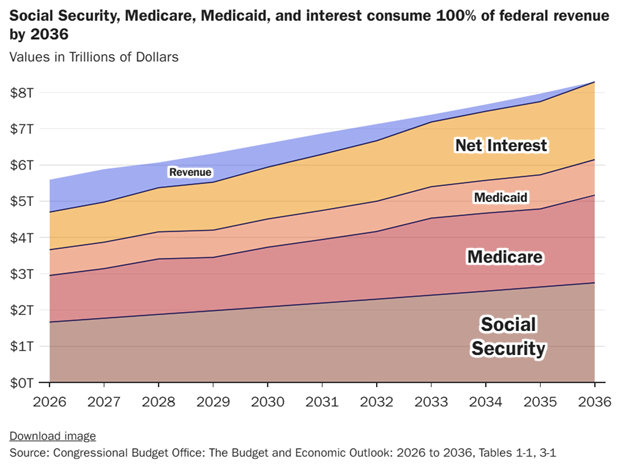
And contrary to the President’s claims, tariffs were never going to prevent national bankruptcy. America’s debt crisis does not arise from a revenue problem. The federal government has an unsustainable spending problem.
Destination-Based Cash Flow Tax > Tariffs?
Border Tax to Get Hearing After Supreme Court Tariff Ruling - Chris Cioffi, Bloomberg ($):
The GOP-led hearing is set to evaluate the US competitiveness and investment advantages of a destination-based cash flow tax, according to information provided by the committee. This type of system would tax imports and exempt exports.
...
Republicans considered a border-adjusted tax in early versions of what became the 2017 GOP tax law, though it didn’t survive deep opposition from retailers.
Is There Another Way?
Tax Treatment of the Pass-Through Business Sector: A Primer - William McBride, Emily Kraschel, and Huaqun Li, Tax Foundation:
...
A few countries have more explicitly integrated their corporate and individual income taxes to avoid double taxation. For instance, Estonia and Latvia tax distributed profits only once, at the business entity level, avoiding tax on retained earnings or on dividends, resulting in an extraordinarily simple business income tax system that applies to all businesses. These countries retain a tax on capital gains. Australia and several other countries use a credit imputation system to integrate their corporate and individual income taxes, so that the shareholder is given a tax credit to offset corporate income taxes paid at the entity level. Another approach that has been considered in the US is to allow corporations to deduct dividends paid.
I think a dividends-paid deduction, combined with withheld excise taxes on non-taxed recipients, like nonprofits and foreign holders, deserves more discussion.
Related: Eide Bailly Passthrough Entity Consulting Services
Supreme Court Considers Tax Sale Equity Theft
Justices Skeptical That Mich. Tax Sale Is Unconstitutional - Maria Koklanaris, Law360 Tax Authority ($):
The justices heard oral arguments in the case of the Pung family, represented by Michael Pung, who said it is entitled to the fair market value of the home, and not what the estate called the low price for which Isabella County sold the home at an auction.
...
Pung claimed a takings clause violation over being denied just compensation and an excessive fines violation over the loss of the family's $194,000 house to pay a tax debt of $2,200. The county sold the home for $76,000 and gave the Pungs just under $74,000.
SCOTUS Justices Ponder Michigan Tax Sale Scheme in Takings Case - Christopher Jardine, Tax Notes ($):
Justices Hint Homeowner Wants Too Much Tax Sale Compensation - Perry Cooper, Bloomberg ($):
“I don’t understand why your argument doesn’t kind of turn the government into Mr. Pung’s real estate agent with some sort of fiduciary duty to maximize the value of his asset” when he’s in this situation because he didn’t pay his taxes, Justice Ketanji Brown Jackson asked Philip Ellison of Outside Legal Counsel PLC, the attorney for the now-deceased homeowner’s estate.
Thoughts on the Supreme Court Oral Argument in the Pung v. Isabella County Takings Case - Ilya Somin, Volokh Conspiracy via Reason. "This is a case about home equity theft."
International Tax: Pillar 1 Fades Away
Tax News & Views International Weekly: Moving Ahead on Amount B - Alex Parker, Eide Bailly:
It’s still often called Pillar Two—but there will almost certainly be no Pillar One.
Blogs and Bits
How to Prevent a Refund Offset – and What to Do If You’re Facing Economic Hardship - Erin Collins, NTA Blog. "A refund offset is when all or part of your federal tax refund is used to pay past-due child support or a debt you owe to the IRS, another federal agency, or a state."
Kwong Case: IRS May Owe You Money — And Cut Penalties - Virginia La Torre Jeker, Forbes. The case could help taxpayers with late filings or assessments where the tax filing deadline fell between early 2020 and mid-2023 (this would mainly cover 2019–2022 tax returns).
Related: Eide Bailly IRS Dispute Resolution and Collections Services.
Court upholds fraud penalties after tax preparer claims unsupported deductions - TaxCoda. "If you make large claims for deductions without supporting records, provide inconsistent explanations, and your story is unconvincing, the Tax Court will not only disallow the deductions but also uphold a 75% civil fraud penalty."
Scholar Al Strikes At Dixieland Boondockery Again - Peter Reilly, Your Tax Matters Partner. " The partnership had claimed a somewhat larger charitable contribution, though. To be specific, North Donald claimed a charitable deduction of $115,391,000. So IRS wanted to give them zero, Judge Lauber allowed them, in my mind, a substantial deduction well over $150,000. On a percentage basis, it is not so much – slightly over 0.15%. Just to be clear, that is not 15% of the total claimed. It is 15% of 1% of the total claimed."
The Hot New U.S. Cultural Export: The 1099-OID Scam
A bonkers dispatch from the UK: The bizarre UK group selling US tax fraud to hundreds of Britons – and prosecuting its critics - Tax Policy Associates:
When YouTuber Salim Fadhley publicised the fraud, Goldberg reported Fadhley to the UK police for harassment, instructed a law firm to send a “cease and desist” letter, and ultimately commenced a private criminal prosecution against him in Chelmsford Magistrates’ Court.
The scheme uses false 1099-OIDs claiming withholding on original issue discount. OID arises when a debt is issued for less than its face amount and without stated interest; the discount from the face is economically the interest on the amount, which builds up to the face amount at maturity. Wikipedia explains the scheme:
The Tax Policy Associates piece says it works like this:
Withholding scams like this are in the IRS Dirty Dozen scam list. The IRS catches most of these, but not all of them. The IRS probably shouldn't pay 1099-OID refunds until it matches it with actual withholding paid, given the persistence of the scam.
What day is it?
It's National Pistachio Day! Clean up your shells.