

Key Takeaways
- Supreme Court rules Trump "IEEPA" tariffs illegal.
- Will government oppose refunds of illegally-collected tariffs?
- Trump lashes out, declares new 15% "Sec. 122" tariffs.
- 122 tariffs legality is questioned.
- What ruling means to consumers and business.
- IRS issues initial manufacturing facility guidance.
- National Banana Bread Day.
Justices Strike Down Trump’s Tariffs - Ann Marimow, New York Times:
...
Writing for the majority, Chief Justice John G. Roberts Jr. said that statute does not authorize the president to impose tariffs.
“The president asserts the extraordinary power to unilaterally impose tariffs of unlimited amount, duration, and scope. In light of the breadth, history, and constitutional context of that asserted authority, he must identify clear congressional authorization to exercise it,” the chief justice wrote.
Supreme Court Strikes Down President Trump’s Tariffs - Erica York and Alex Durante, Tax Policy Blog. " The decision strikes down all the tariffs imposed under the statute, including the 'Liberation Day' tariffs and returns the case to United States Court of International Trade to address the issue of refunds. We estimate more than $160 billion of tariffs have been illegally collected under IEEPA. Removal of the IEEPA tariffs will shield the economy and taxpayers from damage, but uncertainty remains over what the Trump administration will do next."
Trump Takes a Hit on Tariffs, Vows a Work-Around - Caitlin Mullaney, Tax Notes ($):
The 6-3 ruling in Learning Resources Inc. v. Trump and V.O.S. Selections v. United States drew the immediate ire of Trump, who took to Truth Social to blast the decision and vow to circumvent it.
...
“When you read the dissenting opinions there is no way anyone can argue against them . . . foreign countries that have been ripping us off for years are ecstatic, they're so happy, and they're dancing in the streets but they won't be dancing for long that I can assure you," Trump said in a press conference at the White House, echoing statements he posted on Truth Social.
An Annotated Analysis of the Supreme Court’s Tariff Decision - Lydia Wheeler, Wall Street Journal. "The Supreme Court’s decision striking down President Trump’s sweeping global tariffs showed how the justices are split over the scope of the president’s power."
Refunding the Illegal Tariffs
Supreme Court Tariff Ruling to Spur Chaotic Refund Process - Alan Rappeport and Colby Smith, New York Times:
...
The Trump administration’s lawyers previously said in a motion submitted to the trade court that the government would comply with an order to refund the tariff payments if the tariffs were found to be unlawful. But Treasury Secretary Scott Bessent said in a speech in Dallas on Friday that additional litigation involving the refund process could take weeks, months or more — if ever — for the refunds to flow.
A Government Tariff Refund Bait and Switch - Joshua Claybourn, Wall Street Journal:
...
Federal refunds run through importers, the companies that cleared goods through customs. Under 28 U.S.C. 1581(i) and standard customs procedures, reliquidation flows to the importer of record. But importers routinely passed tariff costs on through higher prices. The small manufacturer that paid more for steel components, the retailer who absorbed inflated cost of goods, the family that paid extra for an appliance—none of them will see a check. The law has no mechanism to reach them. Even if importers recover their duties, those who ultimately paid them almost certainly won’t.
The Dodgy Next Round of Tariffs
Trump Says He Will Raise Global Tariff to 15 Percent - Tony Romm and Ana Swanson, New York Times:
...
Mr. Trump had initially set his replacement global rate at 10 percent, using a provision in a law — never before invoked by a president — that allows him to impose an across-the-board tariff for 150 days unless Congress agrees to extend it. In the directive, he indicated it would take effect after midnight on February 24.
The statute caps the rate at 15 percent, limiting the president’s ability to lift it again, though Mr. Trump has signaled he plans to use other trade powers in the coming months to add further taxes on imports.
Trump Pegs New Tariffs to a Payments Crisis Experts Doubt - Shawn Donnan and María Paula Mijares Torres, Bloomberg News:
The potential problem for Trump and his administration with that argument: Many economists — and financial markets so far — don’t see the US teetering on any such precipice. That means his latest import taxes seem likely to lead to yet another legal challenge and more uncertainty for trading partners, companies, consumers and investors.
Andrew McCarthy on "Why Trump's Section 122 Tariffs Are Illegal" - Ilya Somin, The Volokh Conspiracy via Reason, quoting a paywalled article from National Review:
...
The balance of payments is a broader concept than the balance of trade. It accounts for all the economic transactions that take place between the United States and the rest of the world. Even without getting into every kind of transaction that entails, suffice it to say that foreign investment in the United States, coupled with the advantages our nation accrues because the dollar is the world's reserve currency, more than make up for the longstanding trade deficit in goods.
Our overall payments are in balance. There is no crisis.
Such a crisis may not even be possible in an era of floating exchange rates.
The Tariff Ruling and You. How it Affects Old Deals. What it Means for the Budget.
What the Supreme Court throwing out Trump’s tariffs means for you - Rachel Lerman, Washington Post:
Probably not. For the most part, tariffs are paid by importing companies during the Customs and Border Protection process. Individual consumers eventually see some of those fees in the form of cost increases but do not pay tariffs directly.
It’s unlikely that businesses will refund customers for price increases.
What does Trump’s latest tariff threat mean for his previous trade pacts? - Peter Foster, Financial Times. "Despite the fresh legal uncertainty and the fact that many countries will now be paying a lower tariff, analysts said existing deals were unlikely to collapse, although some might be delayed until the legal picture became clearer."
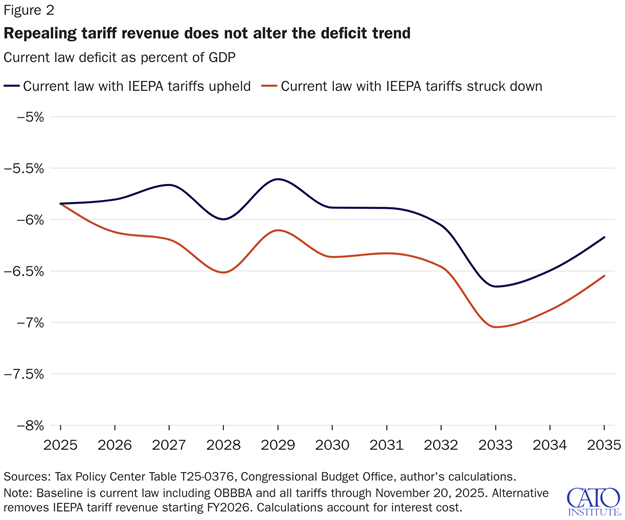
What the SCOTUS Tariff Decision Means for Fiscal Policy in Four Charts - Adam Michel and Santiago Forster, Liberty Taxed. "The tariffs modestly increased revenue but did not meaningfully improve the government’s long-term budget outlook."
Non-Tariff Tax News: Bonus Depreciation, Trump $10B Suit, SALT, Tax Season Progress
IRS Issues Guidance on Bonus Depreciation for Buildings - Nathan Richman, Tax Notes ($):
Tax professionals have been posing questions about how to apply section 168(n), including how to address the limitation on new buildings that are leased, the substantial transformation requirement, and space in a property used to store raw materials and finished products.
Notice 2026-16 addresses many of those questions.
Treasury, IRS Lay Out Eligibility For Depreciation Allowance - Anna Scott Farrell, Law360 Tax Authority:
There are also special rules in the guidance for "integrated facilities" that are on connected pieces of land, allowing them to be treated as a single unit of property.
Property that isn't eligible for the special depreciation allowance includes any part used for offices, administration, parking, research or engineering, the guidance said.
Deadline Looms for Trump to File Response in $10B IRS Suit - Trevor Sikes, Tax Notes ($):
The deadline was imposed by Judge Kathleen M. Williams of the U.S. District Court for the Southern District of Florida in Trump v. IRS through a court order entered February 18. The order notes that Trump mentioned to one of the brief filers his possible intent to file an opposition to their motion, but that he has yet to do so.
...
Although Williams’s court order doesn’t explicitly say so, it’s likely that both motions will be granted and the amici brief will be allowed to be filed and considered by the court if Trump fails to respond by the deadline.
A State Tax Tug of War: The Latest State Tax Legislative Developments - Melissa Menter and Colette Sutton, Eide Bailly:
Tax Refunds Trend Higher in Early Filing Season Data - Benjamin Valdez, Tax Notes ($):
The average refund amount through the week ending February 13 was $2,476, which is 14.2 percent higher than refunds at the same time last year, according to a batch of filing season statistics released by the IRS February 20.
Blogs and Bits
Don’t panic. That’s the first move to make when you get an IRS tax notice. - Kay Bell, Don't Mess With Taxes. " Don’t ignore it. If the IRS says you didn’t pay enough tax, penalties and interest on the due amount will add to any tax liability. If you ignore the matter, the amount you owe will keep growing. Notices also often have deadlines for responding. If you miss them, you’ll find yourself facing more tax troubles."
Related: Eide Bailly IRS Dispute Resolution and Collections Services.
Estimated Taxes Are a Pain. Here’s How to Avoid Costly Penalties. - Laura Saunders, Wall Street Journal. "Filers who owe $1,000 or more of tax normally must pay 90% of their tax bill for the current year long before the April 15 due date to avoid penalties. They can pay through withholding, quarterly estimated taxes or both. The deadline is Dec. 31 for tax paid through withholding. The 2026 quarterly deadlines are April 15, June 15, Sept. 15 and Jan. 15, 2027.
Giving Back Pay Is Hard, Getting Taxes Back Is Even Harder - Robert Wood, Forbes. "Whether the repayment occurs one or two years after the initial payment, or many, is there ever a way to recoup the taxes paid on the money that must be returned? There often is, but since this is about taxes, it is complicated."
Scammers of the Elderly May Not Be Tax-Compliant
Home Repairmen Sentenced To Prison For Tax Fraud After Failing To Report Income Earned Overcharging Elderly Clients For Repairs - US Attorney's Office, Western District of North Carolina (Defendant names omitted, emphasis added):
...
Filed documents show that the defendants defrauded some of the elderly clients by overcharging them for repairs. According to court records, Q would generally approach elderly people about fixing damage to their cars, often in the supermarket parking lot. Once they hired him to do this work, Q would eventually convince the elderly clients that they had all sorts of problems around their homes and that he and C could fix those problems. Then, the repairmen charged the elderly clients outrageous amounts to fix the purported problems, such as painting garage floors, paving a driveway, and replacing windows.
Court records also show that the defendants received payment for their services, but they failed to report their income to the IRS.
Scammers are everywhere, so look out. Keep an eye out for vulnerable family and neighbors. As IRS enforcement funding declines, expect scammers to be emboldened.
What day is it?
It's National Banana Bread Day! Don't let those squishy bananas you found in the back of the pantry go to waste!