

Key Takeaways
- You owe on your 1040? File even if you can't pay.
- You have options.
- Returns claimed on paper pile up.
- Dems float bigger standard deduction, wealth tax.
- GOP seeks "second tax megabill."
- Two-spouse PPP fraudster gets 10 years.
- World Plumbing Day.
A guide to surviving tax season when you owe the government - Michelle Singletary, Washington Post:
...
I can’t stress this enough. Even if you can’t send any money, submit your return by the April 15 deadline. If you need more time to gather your paperwork, request an extension. Just remember: an extension to file isn’t an extension to pay.
The failure-to-file penalty can really sting. If you owe money and fail to file, the “failure-to-file” penalty is 10 times higher than the “failure-to-pay” penalty.
Owe Taxes But Can’t Pay the IRS in Full? Don’t Panic – You Have Options - Erin Collins, NTA Blog. "The most important steps are simple: file your return on time, pay what you can, and then work with the IRS to address the remaining balance. While you can request an extension of time to file, it does not give you more time to pay."
Tax Season Struggles: Clarity Lacking; Paper Refunds Slower, But Bigger
Taxpayers Still Craving Clarity On Tips, OT Amid Tax Season - Asha Glover, Law360 Tax Authority ($):
The Internal Revenue Service has released some initial guidance for claiming the deductions for tips, overtime pay and car loan interest that were included in the budget reconciliation bill enacted in July. It also has offered transition relief for taxpayers claiming the deductions and declared the 2025 tax year as a transition period for enforcement and administration of the information reporting requirements for the tips and overtime tax breaks.
However, the agency has not provided final regulations, leaving taxpayers and practitioners to rely on proposed rules, some of which still have open comment periods.
Paper Refunds Temporarily Frozen for 830,000 Taxpayers, Dems Say - Katie Lobosco, Tax Notes ($):
The CP53E notices are being sent to taxpayers who didn’t include up-to-date bank account information on their tax returns. It’s part of the Trump administration’s initiative to phase out paper-based payments from the government.
If you are in a hurry for a refund, e-file, include your banking information for direct deposit, and make sure that you correctly report your withholdings, estimated taxes, and dependents.
Why Is My Tax Refund Larger This Year? - Garrett Watson and Erica York, Tax Policy Blog. "In other words, your larger-than-ordinary tax refund is because Congress cut taxes for 2025 and withholding continued without adjustments, meaning many taxpayers ended up withholding too much."
Future Tax Policy? Democrats Float Supersized Standard Deduction, Wealth Taxes.
Democratic Senators Hatch Plans to End Income Taxes for Millions of Americans - Richard Rubin, Wall Street Journal:
Sen. Chris Van Hollen (D., Md.) plans to detail a proposal that would end income taxes on individuals making under $46,000 and married couples making under $92,000. Sen. Cory Booker (D., N.J.) proposed a “Keep Your Pay” plan that would more than double the standard deduction to $37,500 for individuals and $75,000 for married couples while increasing the child tax credit and the earned-income tax credit.
...
But every dollar of new revenue used for tax cuts is a dollar that can’t go elsewhere. That means less money to cover the costs of reversing Trump’s tariffs, reviving expired health-insurance subsidies and reversing Medicaid and food-stamp cuts. Tax cuts could make it harder for Democrats to extend Social Security’s solvency and create programs for child care and paid family leave.
Democrats float tax relief plans to home in on affordability - Jacob Fulton, Roll Call:
Alex Jacquez, a Biden administration and Sanders staff alum who is chief of policy and advocacy at the liberal-leaning Groundwork Collective advocacy group, panned Van Hollen’s proposal on social media as “deeply misguided,” adding that “the race to exempt people from paying taxes is only going to erode our fiscal situation and our democracy.”
And Erica York, vice president of federal tax policy for the nonpartisan Tax Foundation, raised the alarm on social media that Booker’s proposal would be “so expensive. North of $8 trillion over the 10-year budget window expensive.”
Sanders And Khanna Push National 5% Annual Billionaire Wealth Tax - Kelly Phillips Erb, Forbes:
...
Despite the projected revenue windfall, the legislation is unlikely to pass. Republicans control the House and Senate and generally oppose major tax increases. Even some moderate Democrats have expressed caution, particularly after recent tax-and-spending proposals stalled.
There are also constitutional concerns. A true wealth tax—one imposed on net worth rather than income—has never been enacted at the federal level. And notably, the Constitution limits direct taxes unless apportioned among the states by population.
These proposals are part of the continuing trend to finance ever-growing government spending with an ever-smaller tax base. The table below comes from this Tax Foundation report on the most-recent available statistics on who pays income taxes:
| Top 1% | 95%–99% | 90%–94% | 75%–89% | 50%–75% | Bottom 50% | |
|---|---|---|---|---|---|---|
| Share of Total Adjusted Gross Income | 22.4% | 15.9% | 11.1% | 20.5% | 18.6% | 11.5% |
| Share of Total Income Taxes Paid | 40.4% | 20.6% | 11.0% | 15.2% | 9.8% | 3.0% |
| Income cutoff (minimum AGI) | $663,164 | $261,591 | $178,611 | $99,857 | $50,339 | — |
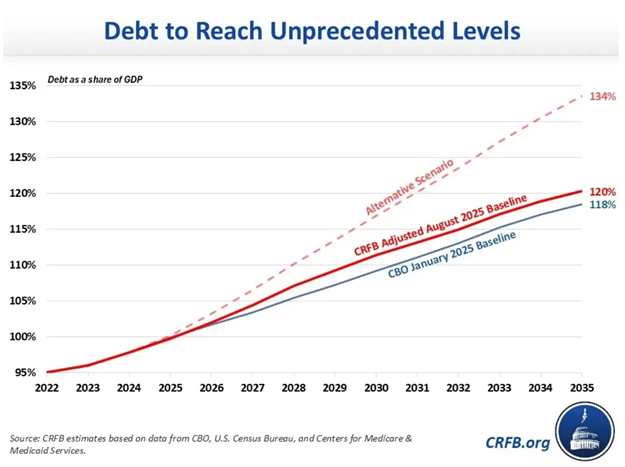
Neither party has an answer for the problems shown in this chart:
Meanwhile in the current Congress
Speaker Mike Johnson (R-La.), his leadership team and many House conservatives want to pass a second GOP bill through reconciliation, a process that allows legislation with a budgetary impact to pass with just a simple majority in the Senate. But as time wanes before November midterms, some key House Republicans are raising doubts that such a heavy lift is possible.
...
House GOP Whip Tom Emmer (R-Minn.) said “some potential details” for a second reconciliation package came up at last week’s elected leadership meeting. He said members spent time brainstorming ideas Monday and Tuesday at the GOP retreat in Doral, Fla., and will likely “tonight, tomorrow” refine possible issues to include in reconciliation.
Odds of New Green Book Slim as Treasury Focuses on OBBBA - Tyrah Burris, Tax Notes ($):
“We wanted to focus our attention on helping the Hill and we provided an enormous amount of technical assistance on that piece of legislation. I think it turned out to be a better piece of legislation as a result,” Kies said March 10 at a U.S. Chamber of Commerce tax policy summit.
Treasury last released a green book in 2024 under the Biden administration, describing the former president’s fiscal 2025 proposals to increase high-income taxes, expand low- and middle-income tax relief, and change the treatment of carried interest.
Senators Continue Push to Bypass Senate with Indexing
...
There are other questions, too. Advocates for indexing insist there’s plenty of literature supporting the idea that the Treasury Department can use its powers to make the change on its own.
But a three-decade old Justice Department analysis crafted during the George H.W. Bush administration found that Congress would have to act to peg capital gains to inflation, which helped stave off the movement to index in the first Trump administration.
The Trump administration has largely reversed a Biden-era effort to increase oversight of partnership’s basis-shifting by working to withdraw rules meant to help the IRS tackle abusive transactions in court. The administration also hollowed out the IRS unit that formed under President Joe Biden to handle those cases, former IRS employees have told Bloomberg Tax.
...
He pointed to an IRS win last month in Tax Court, where a judge ruled the agency properly disallowed a deduction claimed by a partnership after a basis adjustment.
At a high level, incentives are designed to maximize the economic return on public dollars. When they work the way they’re intended, they benefit both sides of the table: businesses reduce costs and improve project economics, while states and communities see job creation, investment, and long‑term economic growth.
Leaving Two Wives Lonely
The defendant was a busy family man, it appears:
Text message evidence of conversations between [Defendant] and his American wife also indicate he used some of the money to buy a "villa" and a Mercedes for his second wife, Zenner added.
A Chicago Tribune story ($) on the same case indicates that the American wife wasn't entirely on board with things, according to an email from her admitted in the case:
The moral? PPP fraud was too easy, even if it didn't pay off in this case. And judges might not be sympathetic to your family obligations if you have too many of them.
What day is it?
It's World Plumbing Day! You take it for granted until it stops working.